Fruit dove profile
Madagascar Blue Pigeon (Alectroenas madagascariensis)
Species at a glance
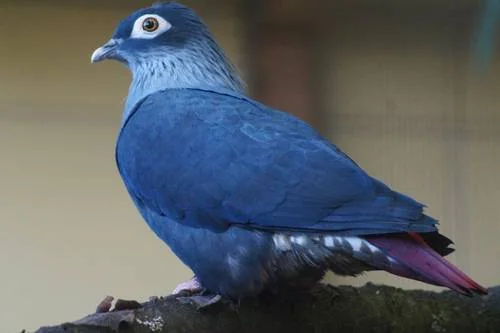
The Madagascar Blue Pigeon (Alectroenas madagascariensis) is a compact, deep blue to slate-coloured forest pigeon with a conspicuous red eye region and reddish tail. It is endemic to Madagascar and has been classified as Near Threatened since 2025. It is currently not represented within the European Fruit Dove Project.
- Distribution
- Humid forest regions of northern and eastern Madagascar.
- Size / characteristics
- about 25–28 cm | dark blue to slate plumage, red iris and bare red orbital skin, and reddish tail | sexes externally similar
- Status
- Currently not represented in the project stock
Description
The Madagascar Blue Pigeon is a characteristic endemic pigeon of Madagascar's humid forests. Its predominantly dark blue to slate plumage, red iris and bare red orbital skin, and reddish tail make it unmistakable. Males and females are externally very similar. The species is monotypic. It inhabits forest from lowland to montane zones and may also occur in more heavily modified but still wooded habitats. Forest loss and hunting pressure led to its classification as Near Threatened.
Profile & short facts for Madagascar Blue Pigeon
| English name | Madagascar Blue Pigeon |
|---|---|
| German name | Madagaskar-Fruchttaube |
| Scientific name | Alectroenas madagascariensis |
| Genus | Alectroenas |
| Category | Fruit doves of other genera |
| Distribution | Humid forest regions of northern and eastern Madagascar. |
| Subspecies | Monotypic; no subspecies are currently widely recognised. |
| Size / characteristics | about 25–28 cm | dark blue to slate plumage, red iris and bare red orbital skin, and reddish tail | sexes externally similar |
| Status | Currently not represented in the project stock |
Habitat and natural range
Humid lowland, hill and montane forest, mature secondary woodland, and regionally wooded gardens and heavily degraded former forest.
Feeding in the European Fruit Dove Project
The species feeds mainly on fruit and berries and plays an important role in forest seed dispersal. In human care, a varied selection of suitable fruits should be combined with a balanced complementary food for frugivorous pigeons. As no project birds are currently held, there are no recent project-specific long-term feeding data.
Husbandry in the European Fruit Dove Project
This robust but disturbance-sensitive forest pigeon requires a spacious, densely structured and permanently frost-free aviary with open flight paths, stable elevated perches and protected retreat areas. Calm husbandry routines and multiple feeding sites are important. Specific statements on mixed-species housing should be based only on documented observations.
Breeding and offspring
The species normally lays a single egg. Quiet, elevated and load-bearing nest sites with sturdy twig material should be provided in any prospective holding. As it is currently absent from the project stock, there are no recent project data on pair formation, incubation or juvenile development.
Subspecies and systematics
Monotypic; no subspecies are currently widely recognised.
Special notes on the species
The species was uplisted from Least Concern to Near Threatened in 2025. Its red eye region and reddish tail contrast strongly with the dark blue body plumage.
Conservation status
| IUCN | Near Threatened |
|---|---|
| CITES | Not listed |
| EU species protection | Not listed |
| Ring size | 7,0 mm |
Further sources
Images of the Madagascar Blue Pigeon
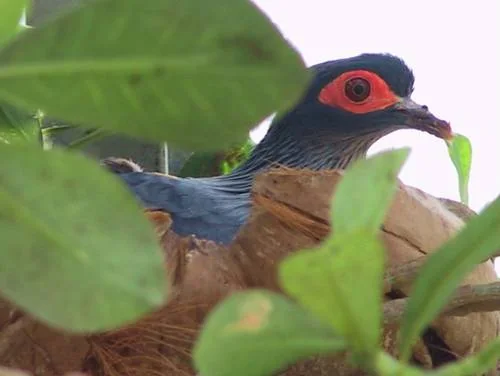
Image credits
- Brütende Madagaskar-Fruchttaube (© Simon Bruslund)
- Madagaskar-Fruchttaube Jungvogel (© Vogelpark Walsrode)
- Madagaskar-Fruchttaube im Vogelpark Walsrode (© Johannes Pfleiderer)
- Madagaskar-Fruchttaube im Zoo Köln (© Thomas Breuer)