Fruit dove profile
Mountain Imperial Pigeon (Ducula badia)
Species at a glance
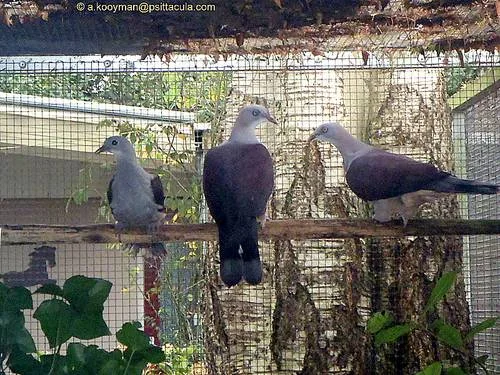
The Mountain Imperial Pigeon (Ducula badia) is a very large Asian imperial pigeon with a maroon-brown back, pale neck and dark tail. It ranges from the Himalayas and southern China to the Malay Peninsula, Sumatra, Borneo and western Java. The stock within the European Fruit Dove Project is very small.
- Distribution
- From the Himalayas and northeastern India through Myanmar, southern China and Indochina to the Malay Peninsula, Sumatra, Borneo and western Java.
- Size / characteristics
- about 43–51 cm | chestnut to vinous-brown back, pale vinous-grey underparts, whitish throat and dark tail with a pale transverse band | sexes externally similar
- Status
- Project stock very small
Description
The Mountain Imperial Pigeon is one of the largest imperial pigeons in Asia. It is characterised by a chestnut to vinous-brown back, pale neck with a whitish throat, and a dark tail with a pale transverse band. Males and females are externally similar. The species has a very broad range and may make seasonal altitudinal movements between feeding and resting areas. Following the widely adopted separation of the Malabar Imperial Pigeon, three subspecies are recognised. The very small project stock requires carefully coordinated population and breeding management.
Profile & short facts for Mountain Imperial Pigeon
| English name | Mountain Imperial Pigeon |
|---|---|
| German name | Fahlbauch-Fruchttaube |
| Scientific name | Ducula badia |
| Genus | Ducula |
| Category | Ducula - imperial pigeons |
| Distribution | From the Himalayas and northeastern India through Myanmar, southern China and Indochina to the Malay Peninsula, Sumatra, Borneo and western Java. |
| Subspecies | Ducula b. insignis – Himalayan foothills from Nepal to Bhutan and Sikkim | Ducula b. griseicapilla – Myanmar, southwestern China, Hainan, Thailand and Indochina | Ducula b. badia – Malay Peninsula and Mergui Archipelago to Sumatra, Borneo and western Java. Ducula cuprea of the Western Ghats is now generally treated as the separate Malabar Imperial Pigeon. |
| Size / characteristics | about 43–51 cm | chestnut to vinous-brown back, pale vinous-grey underparts, whitish throat and dark tail with a pale transverse band | sexes externally similar |
| Status | Project stock very small |
Habitat and natural range
Evergreen and deciduous forest from the lowlands into montane zones, often in foothill and mountain forest; seasonal altitudinal movements occur regionally.
Feeding in the European Fruit Dove Project
The species feeds mainly on fruit and berries, including larger forest fruits that may be swallowed whole. In human care, a varied selection of suitable fruits should be combined with a balanced complementary food for frugivorous pigeons. In very large birds, body weight, condition and actual food intake require particularly close observation.
Husbandry in the European Fruit Dove Project
This large and powerful species requires a particularly spacious aviary with long unobstructed flight paths, stable elevated perches and adequately sized feeding stations. Its occurrence in mountain forest must not be interpreted as tolerance of cold housing; accommodation should remain frost-free and climatically stable. Multiple retreat and escape areas help reduce conflict.
Breeding and offspring
The clutch normally consists of a single egg. Quiet, elevated and highly load-bearing nest sites with sturdy twig material should be provided. In a very small project stock, pair formation, origin, laying, hatching and rearing should be documented completely. Species-specific timing data should be generalised only from reliable breeding records.
Subspecies and systematics
Ducula b. insignis – Himalayan foothills from Nepal to Bhutan and Sikkim | Ducula b. griseicapilla – Myanmar, southwestern China, Hainan, Thailand and Indochina | Ducula b. badia – Malay Peninsula and Mergui Archipelago to Sumatra, Borneo and western Java. Ducula cuprea of the Western Ghats is now generally treated as the separate Malabar Imperial Pigeon.
Special notes on the species
The species has one of the broadest ranges among Asian Ducula pigeons. Its maroon back and notably deep voice are characteristic features.
Conservation status
| IUCN | Least Concern |
|---|---|
| CITES | Not listed |
| EU species protection | Not listed |
| Ring size | 11,0–12,0 mm |
Further sources
Images of the Mountain Imperial Pigeon
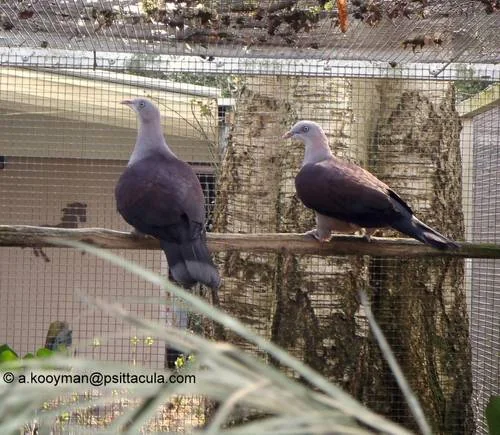
Image credits
Fahlbauch-Fruchttauben (© Arie Kooyman)