Fruit dove profile
Spectacled Imperial Pigeon (Ducula perspicillata)
Species at a glance
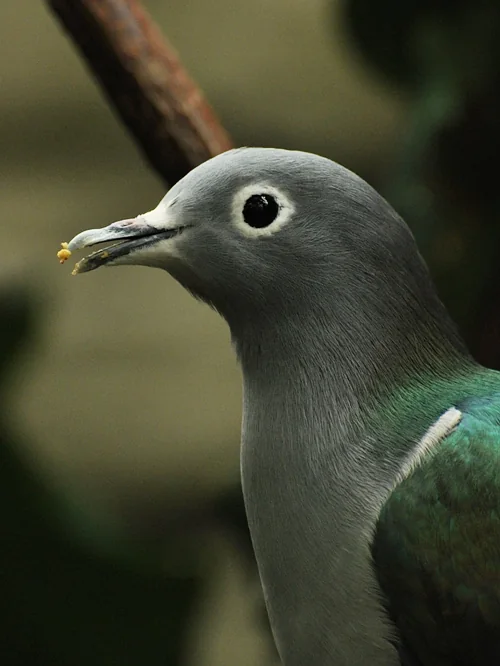
The Spectacled Imperial Pigeon (Ducula perspicillata) is a large green island pigeon with an ash-grey head and conspicuous pale eye-ring. Its currently recognised range lies in the northern Moluccas and on Kofiau. The stock within the European Fruit Dove Project is extremely small.
- Distribution
- Northern Moluccas, including Halmahera and surrounding islands, and Kofiau in the Raja Ampat Islands west of New Guinea.
- Size / characteristics
- about 42–43 cm | ash-grey head, conspicuous pale eye-ring and mainly green upperparts | sexes externally very similar
- Status
- Project stock extremely small
Description
The Spectacled Imperial Pigeon is readily identified by its ash-grey head and prominent pale eye-ring. The back and wings are mainly green, while the neck and underparts may show grey to vinous tones. Males and females are externally very similar. The species is restricted to islands in the northern Moluccas and Kofiau. The population formerly treated as the subspecies neglecta is now generally recognised as the separate Seram Imperial Pigeon. Because the project stock is extremely small, pedigree, pair formation and every breeding result require particularly careful documentation.
Profile & short facts for Spectacled Imperial Pigeon
| English name | Spectacled Imperial Pigeon |
|---|---|
| German name | Brillenfruchttaube |
| Scientific name | Ducula perspicillata |
| Genus | Ducula |
| Category | Ducula - imperial pigeons |
| Distribution | Northern Moluccas, including Halmahera and surrounding islands, and Kofiau in the Raja Ampat Islands west of New Guinea. |
| Subspecies | Monotypic in current international checklists. The population of the southern Moluccas formerly treated as Ducula perspicillata neglecta is now generally recognised as the separate Seram Imperial Pigeon (Ducula neglecta). |
| Size / characteristics | about 42–43 cm | ash-grey head, conspicuous pale eye-ring and mainly green upperparts | sexes externally very similar |
| Status | Project stock extremely small |
Habitat and natural range
Tropical moist lowland and hill forest, forest edges, and regionally more heavily modified or degraded woodland.
Feeding in the European Fruit Dove Project
The species feeds mainly on fruit and berries, taken primarily in the canopy. In human care, a varied selection of suitable fruits should be combined with a balanced complementary food for frugivorous pigeons. In an extremely small population, food intake, body weight and individual tolerance should be documented consistently.
Husbandry in the European Fruit Dove Project
As a large and active canopy pigeon, the species requires a spacious, structured aviary with open flight paths, stable elevated perches and protected retreat areas. Housing must remain frost-free and climatically stable throughout the year. Disturbance, competition at feeding sites and unsuitable mixed-species combinations should be avoided, especially in a small conservation population.
Breeding and offspring
Large imperial pigeons normally lay a single egg. Quiet, elevated and load-bearing nest sites with sturdy twig material should be provided. Because the project stock is extremely small, pair selection, pedigree, laying, hatching and juvenile development must be recorded completely. Exact incubation or nestling periods should be included only when supported by verified records.
Subspecies and systematics
Monotypic in current international checklists. The population of the southern Moluccas formerly treated as Ducula perspicillata neglecta is now generally recognised as the separate Seram Imperial Pigeon (Ducula neglecta).
Special notes on the species
The pale eye-ring gives the species both its German and current international English name. Recognition of the Seram Imperial Pigeon as a separate species substantially changes the range and subspecies information used for this profile.
Conservation status
| IUCN | Least Concern |
|---|---|
| CITES | Not listed |
| EU species protection | Not listed |
| Ring size | 10,0 mm |
Further sources
Images of the Spectacled Imperial Pigeon
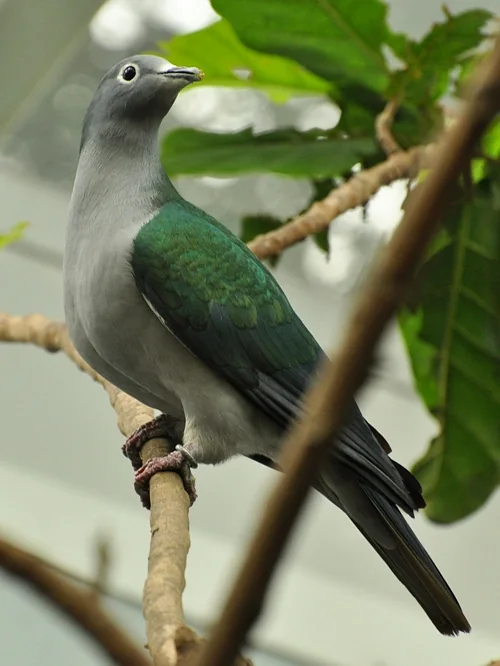
Image credits
- Brillenfruchttaube im Houston Zoo (© Johannes Pfleiderer)
- Brillenfruchttaube (© Johannes Pfleiderer)