Fruit dove profile
Grey Imperial Pigeon (Ducula pickeringii)
Species at a glance
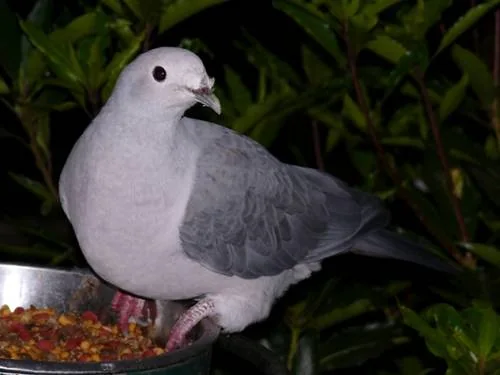
The Grey Imperial Pigeon (Ducula pickeringii) is a large, predominantly pearl-grey island pigeon with darker wings and a fine pale eye-ring. It occurs on several small island groups between Borneo, Sulawesi and the southern Philippines. The species is currently not represented within the European Fruit Dove Project.
- Distribution
- The Sulu Archipelago and smaller islands north and northeast of Borneo, together with Miangas and the Talaud Islands between Sulawesi and the Philippines.
- Size / characteristics
- about 40 cm | pearl-grey underparts, dark grey to greenish-glossed wings and back, dark tail and a fine pale eye-ring | sexes externally similar
- Status
- Currently not represented in the project stock
Description
The Grey Imperial Pigeon has a notably uniform appearance, with pearl-grey underparts and darker wings, back and tail. In favourable light the upperparts may show a greenish sheen, while a narrow pale eye-ring assists identification. Males and females are externally very similar. Its small and fragmented range includes islands in the Sulu Sea as well as Miangas and the Talaud Islands. The species is currently classified as Near Threatened. As it is not held within the project at present, husbandry and breeding notes are clearly presented as general specialist guidance rather than current project experience.
Profile & short facts for Grey Imperial Pigeon
| English name | Grey Imperial Pigeon |
|---|---|
| German name | Pickeringfruchttaube |
| Scientific name | Ducula pickeringii |
| Genus | Ducula |
| Category | Ducula - imperial pigeons |
| Distribution | The Sulu Archipelago and smaller islands north and northeast of Borneo, together with Miangas and the Talaud Islands between Sulawesi and the Philippines. |
| Subspecies | Ducula p. pickeringii – Sulu Archipelago and small islands north and northeast of Borneo | Ducula p. langhornei – Bolod and Loran in the Sulu Archipelago | Ducula p. palmasensis – Miangas and the Talaud Islands. |
| Size / characteristics | about 40 cm | pearl-grey underparts, dark grey to greenish-glossed wings and back, dark tail and a fine pale eye-ring | sexes externally similar |
| Status | Currently not represented in the project stock |
Habitat and natural range
Forest, mature secondary woodland, forest edges and wooded cultivated landscapes on small offshore islands.
Feeding in the European Fruit Dove Project
The species feeds mainly on fruit and berries found in the canopy and often swallowed whole. In human care, a varied selection of suitable fruits should be combined with a balanced complementary food for frugivorous pigeons. No current long-term project feeding data are available for this species.
Husbandry in the European Fruit Dove Project
As a large canopy-dwelling island pigeon, the species requires a spacious, well-structured and permanently frost-free aviary with open flight paths, stable elevated perches and protected retreat areas. Several feeding sites help reduce competition. Specific statements on mixed-species housing should be based only on documented husbandry observations.
Breeding and offspring
Large imperial pigeons normally lay a single egg. Quiet, elevated and load-bearing nest sites with sturdy twig material should be provided in any prospective holding. As the species is currently absent from the project stock, there are no recent project data on pair formation, incubation or juvenile development.
Subspecies and systematics
Ducula p. pickeringii – Sulu Archipelago and small islands north and northeast of Borneo | Ducula p. langhornei – Bolod and Loran in the Sulu Archipelago | Ducula p. palmasensis – Miangas and the Talaud Islands.
Special notes on the species
The species is restricted to several small and widely separated island groups. This fragmented distribution and the loss of suitable forest are especially important when assessing its populations.
Conservation status
| IUCN | Near Threatened |
|---|---|
| CITES | Not listed |
| EU species protection | Not listed |
| Ring size | 9,0–10,0 mm |
Further sources
Images of the Grey Imperial Pigeon
Image credits
Pickeringfruchttaube im Zoo San Diego (© Johannes Pfleiderer)