Fruit dove profile
Pinon's Imperial Pigeon (Ducula pinon)
Species at a glance
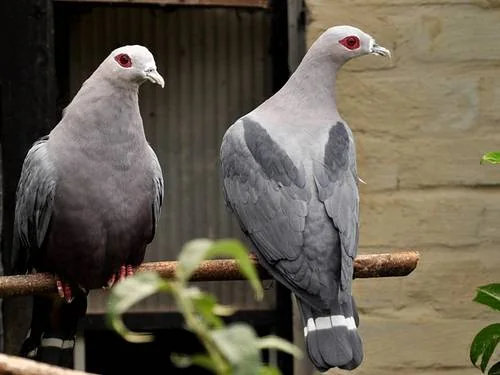
Pinon's Imperial Pigeon (Ducula pinon) is a very large imperial pigeon of New Guinea with a grey body, darker wings and a conspicuous red iris and orbital skin. Four subspecies occupy different parts of New Guinea and its offshore islands. The project stock is small.
- Distribution
- New Guinea and numerous offshore islands, including western Papuan islands, the Aru Islands, Yapen, and the D'Entrecasteaux and Louisiade archipelagos.
- Size / characteristics
- about 44–48 cm | grey, slightly lavender-toned body, darker wings and tail, deep chestnut belly and undertail, and vivid red iris and orbital skin | sexes externally similar
- Status
- Project stock small
Description
Pinon's Imperial Pigeon is among the largest members of the genus Ducula in New Guinea. Its grey, slightly lavender-toned body contrasts with darker wings and tail, while the iris and bare orbital skin are vivid red. Males and females are externally similar. The four subspecies differ mainly in distribution and in some plumage details. The small stock within the European Fruit Dove Project requires coordinated pair formation and reliable documentation of subspecies, origin and offspring.
Profile & short facts for Pinon's Imperial Pigeon
| English name | Pinon's Imperial Pigeon |
|---|---|
| German name | Rotaugen-Fruchttaube |
| Scientific name | Ducula pinon |
| Genus | Ducula |
| Category | Ducula - imperial pigeons |
| Distribution | New Guinea and numerous offshore islands, including western Papuan islands, the Aru Islands, Yapen, and the D'Entrecasteaux and Louisiade archipelagos. |
| Subspecies | Ducula p. pinon – western Papuan islands, Aru, and southern New Guinea from the Mimika region to Hall Sound | Ducula p. rubiensis – western and southwestern New Guinea between Cenderawasih Bay and Etna Bay | Ducula p. jobiensis – Yapen and northern New Guinea including offshore islands | Ducula p. salvadorii – D'Entrecasteaux and Louisiade archipelagos. |
| Size / characteristics | about 44–48 cm | grey, slightly lavender-toned body, darker wings and tail, deep chestnut belly and undertail, and vivid red iris and orbital skin | sexes externally similar |
| Status | Project stock small |
Habitat and natural range
Lowland rainforest, swamp and riverine forest, mangroves, forest edges and mature secondary woodland.
Feeding in the European Fruit Dove Project
The species feeds mainly on fruit and berries and can swallow relatively large forest fruits whole. In human care, a varied fruit ration should be combined with a balanced complementary food for frugivorous pigeons. In such large birds, body weight, condition and actual food intake require regular monitoring.
Husbandry in the European Fruit Dove Project
This very large and powerful species requires substantial usable flight space, stable elevated perches, generously sized feeding stations and protected retreat areas. Housing must remain frost-free and climatically stable throughout the year. Multiple feeding and escape areas help limit competition in small groups or mixed-species settings.
Breeding and offspring
The clutch normally consists of a single egg. Quiet, elevated and particularly load-bearing nest sites with sturdy twig material should be provided. In the small project stock, subspecies identity, pair formation, pedigree, hatching and juvenile development should be recorded completely.
Subspecies and systematics
Ducula p. pinon – western Papuan islands, Aru, and southern New Guinea from the Mimika region to Hall Sound | Ducula p. rubiensis – western and southwestern New Guinea between Cenderawasih Bay and Etna Bay | Ducula p. jobiensis – Yapen and northern New Guinea including offshore islands | Ducula p. salvadorii – D'Entrecasteaux and Louisiade archipelagos.
Special notes on the species
The vivid red eye region is the most conspicuous identification feature. In flight the species can resemble the Collared Imperial Pigeon, but it lacks a complete black collar.
Conservation status
| IUCN | Least Concern |
|---|---|
| CITES | Not listed |
| EU species protection | Not listed |
| Ring size | 12,0 mm |
Further sources
Images of the Pinon's Imperial Pigeon
Image credits
- Rotaugen-Fruchttauben (© Johannes Pfleiderer)
- Rotaugen-Fruchttaube im Vogelpark Walsrode (© Johannes Pfleiderer)