Fruit dove profile
Red-knobbed Imperial Pigeon (Ducula rubricera)
Species at a glance
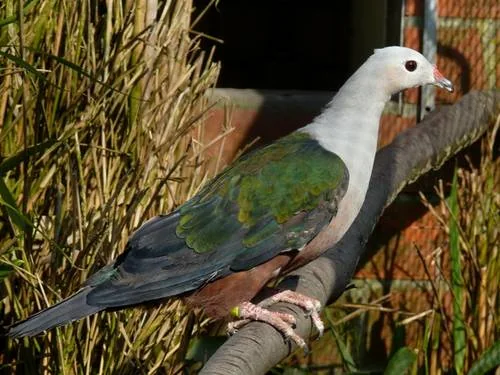
The Red-knobbed Imperial Pigeon (Ducula rubricera) is a large imperial pigeon of the Bismarck Archipelago and Solomon Islands. Its name refers to the vivid red cere and knob-like swelling at the base of the bill. The stock within the European Fruit Dove Project is small and still being developed.
- Distribution
- Bismarck Archipelago and the Solomon Islands including Bougainville, but excluding Rennell.
- Size / characteristics
- about 38–45 cm | conspicuous red cere with a knob-like swelling at the base of the bill, grey head and underparts, and dark green to bronze-glossed upperparts | sexes externally similar
- Status
- Project stock small and still being developed
Description
The Red-knobbed Imperial Pigeon is unmistakable because of the conspicuous red cere at the base of the bill. The head and underparts are mainly grey, while the back and wings show a dark green to bronze sheen. The two recognised subspecies differ mainly in the colour of the neck and breast and in distribution. Males and females are externally similar. The small and growing project stock should be coordinated closely by subspecies, origin and pedigree.
Profile & short facts for Red-knobbed Imperial Pigeon
| English name | Red-knobbed Imperial Pigeon |
|---|---|
| German name | Rothöcker-Fruchttaube |
| Scientific name | Ducula rubricera |
| Genus | Ducula |
| Category | Ducula - imperial pigeons |
| Distribution | Bismarck Archipelago and the Solomon Islands including Bougainville, but excluding Rennell. |
| Subspecies | Ducula r. rubricera – Bismarck Archipelago | Ducula r. rufigula – Solomon Islands including Bougainville, except Rennell. |
| Size / characteristics | about 38–45 cm | conspicuous red cere with a knob-like swelling at the base of the bill, grey head and underparts, and dark green to bronze-glossed upperparts | sexes externally similar |
| Status | Project stock small and still being developed |
Habitat and natural range
Tropical lowland and foothill rainforest, forest edges and mature secondary woodland.
Feeding in the European Fruit Dove Project
The species feeds mainly on fruit and berries and forages primarily in trees. In human care, a varied fruit ration should be combined with a balanced complementary food for frugivorous pigeons. In the small developing project stock, body weight, food intake and condition should be recorded regularly.
Husbandry in the European Fruit Dove Project
This large canopy pigeon requires a spacious, well-structured and permanently frost-free aviary with open flight paths, stable high perches and protected retreat areas. Multiple feeding sites and sufficient distance between preferred perches help reduce competition. Behaviour during pair formation and breeding requires particularly close observation.
Breeding and offspring
The clutch normally consists of a single egg. Quiet, elevated and load-bearing nest sites with sturdy twig material should be offered. As the project stock is small and still developing, subspecies identity, pair formation, pedigree, hatching and juvenile development must be documented completely.
Subspecies and systematics
Ducula r. rubricera – Bismarck Archipelago | Ducula r. rufigula – Solomon Islands including Bougainville, except Rennell.
Special notes on the species
The red, knob-like enlarged cere is the most distinctive feature. The two subspecies represent separate populations in the Bismarck Archipelago and the Solomon Islands.
Conservation status
| IUCN | Least Concern |
|---|---|
| CITES | Not listed |
| EU species protection | Not listed |
| Ring size | 11,0 mm |
Further sources
Images of the Red-knobbed Imperial Pigeon
Image credits
Rothöcker-Fruchttaube (© Johannes Pfleiderer)