Fruit dove profile
Purple-tailed Imperial Pigeon (Ducula rufigaster)
Species at a glance
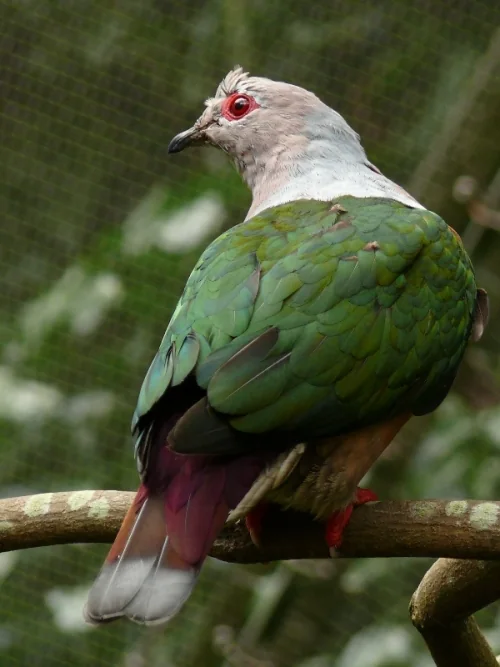
The Purple-tailed Imperial Pigeon (Ducula rufigaster) is a large forest pigeon of New Guinea with a grey head, glossy greenish upperparts and a distinctive rufous to chestnut underside. Two subspecies are recognised. The stock within the European Fruit Dove Project is currently very small.
- Distribution
- New Guinea including Yapen, and western offshore islands including parts of Raja Ampat.
- Size / characteristics
- large imperial pigeon | grey head, glossy greenish upperparts, rufous to chestnut breast and belly, and a purplish sheen on the tail | sexes externally similar
- Status
- Project stock very small
Description
The Purple-tailed Imperial Pigeon is a distinctively coloured member of the genus Ducula. Its grey head and glossy greenish upperparts contrast with the warm rufous to chestnut breast and belly, while the tail may show a purplish sheen. Males and females are externally similar. The species inhabits the rainforests of New Guinea and several islands to the west. The very small project stock makes careful documentation of origin, pair formation and breeding results especially important.
Profile & short facts for Purple-tailed Imperial Pigeon
| English name | Purple-tailed Imperial Pigeon |
|---|---|
| German name | Rostbauch-Fruchttaube |
| Scientific name | Ducula rufigaster |
| Genus | Ducula |
| Category | Ducula - imperial pigeons |
| Distribution | New Guinea including Yapen, and western offshore islands including parts of Raja Ampat. |
| Subspecies | Ducula r. rufigaster – Bird's Head region and Raja Ampat, and southern New Guinea east to approximately Orangerie Bay | Ducula r. uropygialis – northern New Guinea including Yapen east to the Huon Gulf. |
| Size / characteristics | large imperial pigeon | grey head, glossy greenish upperparts, rufous to chestnut breast and belly, and a purplish sheen on the tail | sexes externally similar |
| Status | Project stock very small |
Habitat and natural range
Moist lowland and hill rainforest, swamp forest and mature secondary woodland; the species is mainly associated with the canopy.
Feeding in the European Fruit Dove Project
The species feeds mainly on fruit and berries and forages primarily in trees. In human care, a varied fruit ration should be combined with a balanced complementary food for frugivorous pigeons. In the very small project stock, food intake, body weight and condition should be documented regularly.
Husbandry in the European Fruit Dove Project
This large forest pigeon requires a spacious, structured and permanently frost-free aviary with open flight paths, stable elevated perches and dense cover for undisturbed resting. Several accessible feeding sites reduce competition. Mixed-species housing should be attempted only with sufficient space and close observation.
Breeding and offspring
Large imperial pigeons normally lay a single egg. Quiet, elevated and load-bearing nest sites with sturdy twig material should be provided. Because the project stock is very small, pair formation, pedigree, laying, hatching and juvenile development should be recorded completely; unverified timing data are not generalised.
Subspecies and systematics
Ducula r. rufigaster – Bird's Head region and Raja Ampat, and southern New Guinea east to approximately Orangerie Bay | Ducula r. uropygialis – northern New Guinea including Yapen east to the Huon Gulf.
Special notes on the species
The warm rufous underparts and purplish sheen of the tail distinguish the species from many other large imperial pigeons of New Guinea.
Conservation status
| IUCN | Least Concern |
|---|---|
| CITES | Not listed |
| EU species protection | Not listed |
| Ring size | 10,0 mm |
Further sources
Images of the Purple-tailed Imperial Pigeon
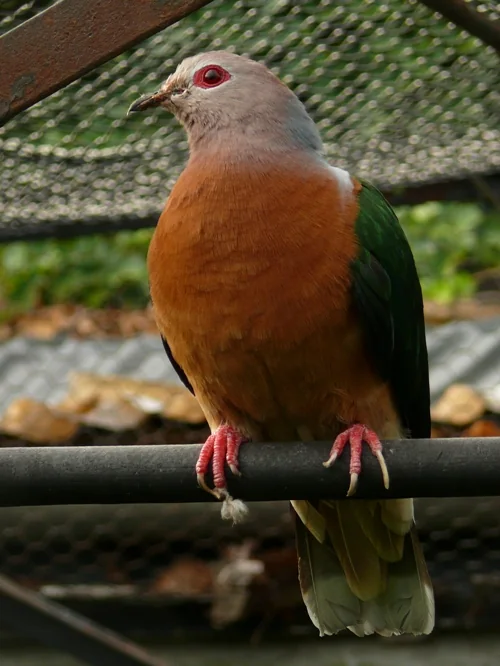
Image credits
Rostbauch-Fruchttaube (© Johannes Pfleiderer)