Fruit dove profile
Zoe's Imperial Pigeon (Ducula zoeae)
Species at a glance
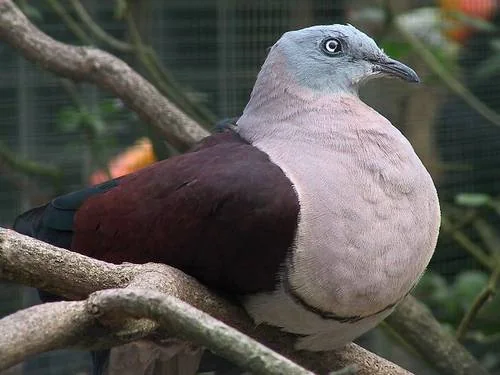
Zoe's Imperial Pigeon (Ducula zoeae) is a large, monotypic imperial pigeon of New Guinea. Its narrow dark breast band clearly separates the grey breast from the chestnut to vinous belly. The species is currently not represented within the European Fruit Dove Project.
- Distribution
- New Guinea and immediately adjacent islands.
- Size / characteristics
- about 38–41 cm | around 575–592 g | grey head and breast, narrow dark breast band and chestnut to vinous belly | sexes externally similar
- Status
- Currently not represented in the project stock
Description
Zoe's Imperial Pigeon has an unusual and readily recognisable plumage pattern. The head and breast are mainly grey, while a narrow dark band separates the breast from the warm chestnut to vinous belly. The greenish upperparts show a metallic sheen. Males and females are externally very similar. The species is restricted to New Guinea and immediately adjacent islands and is treated without recognised subspecies. As there is currently no project stock, husbandry information must remain clearly identified as general specialist knowledge rather than current project experience.
Profile & short facts for Zoe's Imperial Pigeon
| English name | Zoe's Imperial Pigeon |
|---|---|
| German name | Halsband-Fruchttaube |
| Scientific name | Ducula zoeae |
| Genus | Ducula |
| Category | Ducula - imperial pigeons |
| Distribution | New Guinea and immediately adjacent islands. |
| Subspecies | Monotypic; no subspecies are currently widely recognised. |
| Size / characteristics | about 38–41 cm | around 575–592 g | grey head and breast, narrow dark breast band and chestnut to vinous belly | sexes externally similar |
| Status | Currently not represented in the project stock |
Habitat and natural range
Primary and mature secondary rainforest in lowland and hill country, mainly below the higher montane forest zone.
Feeding in the European Fruit Dove Project
The species feeds mainly on fruit and berries found in the forest canopy. In human care, a varied selection of suitable fruits should be combined with a balanced complementary food for frugivorous pigeons. As no birds are currently held within the project, there are no reliable project-specific feeding data.
Husbandry in the European Fruit Dove Project
As a large forest pigeon, the species requires a spacious, structured and permanently frost-free aviary with open flight paths, elevated perches and dense cover for resting and retreat. Feeding sites should be protected and easily accessible. Specific statements on mixed-species housing must be derived from documented husbandry observations.
Breeding and offspring
Large imperial pigeons normally lay a single egg. Quiet, elevated and load-bearing nest sites with sturdy twig material should be provided. As the species is currently absent from the project stock, there are no recent project data on pair formation, incubation or juvenile development.
Subspecies and systematics
Monotypic; no subspecies are currently widely recognised.
Special notes on the species
The narrow dark breast band is the most distinctive identification feature. Morphologically, the species occupies a comparatively distinctive position within the genus Ducula.
Conservation status
| IUCN | Least Concern |
|---|---|
| CITES | Not listed |
| EU species protection | Not listed |
| Ring size | 10,0–11,0 mm |
Further sources
Images of the Zoe's Imperial Pigeon
Image credits
- Halsband-Fruchttaube (© Vogelpark Walsrode)
- Halsband-Fruchttaube (© Johannes Pfleiderer)