Fruit dove profile
Papuan Mountain Pigeon (Gymnophaps albertisii)
Species at a glance
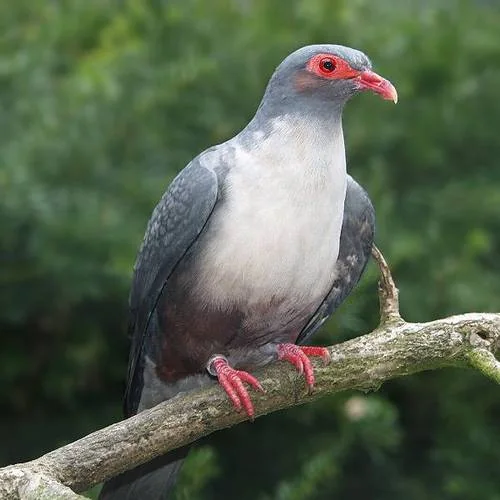
The Papuan Mountain Pigeon (Gymnophaps albertisii) is a robust mountain pigeon with a dark head, grey underparts and conspicuous red iris and orbital skin. It inhabits mountain forest in New Guinea, Yapen and the Bismarck Archipelago, with a separate subspecies on Bacan. The stock within the European Fruit Dove Project is still being developed, and breeding is considered challenging.
- Distribution
- Mountain regions of New Guinea including Yapen and the Bismarck Archipelago, and Bacan in the northern Moluccas.
- Size / characteristics
- about 33–36 cm | dark head, grey to slate underparts, dark upperparts, and red iris with bare red orbital skin | sexes externally similar
- Status
- Stock still being developed; breeding is not straightforward
Description
The Papuan Mountain Pigeon is adapted to forested mountain regions. It is characterised by a dark head, grey to slate-coloured body and a red iris with bare red orbital skin. Males and females are externally very similar. Outside the breeding season, the species may occur in large and conspicuous flocks and travel considerable distances between resting and feeding areas. Two subspecies are recognised. The project stock is not yet stable, so origin, pair formation and breeding results require close documentation.
Profile & short facts for Papuan Mountain Pigeon
| English name | Papuan Mountain Pigeon |
|---|---|
| German name | Albertistaube |
| Scientific name | Gymnophaps albertisii |
| Genus | Gymnophaps |
| Category | Fruit doves of other genera |
| Distribution | Mountain regions of New Guinea including Yapen and the Bismarck Archipelago, and Bacan in the northern Moluccas. |
| Subspecies | Gymnophaps a. albertisii – New Guinea including Yapen and the Bismarck Archipelago | Gymnophaps a. exsul – montane forest on Bacan in the northern Moluccas. |
| Size / characteristics | about 33–36 cm | dark head, grey to slate underparts, dark upperparts, and red iris with bare red orbital skin | sexes externally similar |
| Status | Stock still being developed; breeding is not straightforward |
Habitat and natural range
Montane and cloud forest and other moist forest at middle to higher elevations; regionally descending to lower forest levels when feeding.
Feeding in the European Fruit Dove Project
The species feeds mainly on fruit and berries taken from trees and shrubs. In human care, a varied selection of suitable fruits should be combined with a balanced complementary food for frugivorous pigeons. In a small developing stock, food intake, body weight and condition should be documented regularly.
Husbandry in the European Fruit Dove Project
This robust and active species requires a spacious, well-structured and permanently frost-free aviary with open flight paths, stable elevated perches and protected resting areas. Its mountain-forest origin must not be interpreted as general tolerance of cold housing. Multiple feeding and escape sites help reduce disturbance and competition.
Breeding and offspring
Quiet, elevated and load-bearing nest sites with suitable twig material should be provided. As breeding is considered difficult within the project, pair formation, laying, hatching, rearing and possible disturbance factors should be recorded systematically. Unverified incubation or nestling periods are not generalised.
Subspecies and systematics
Gymnophaps a. albertisii – New Guinea including Yapen and the Bismarck Archipelago | Gymnophaps a. exsul – montane forest on Bacan in the northern Moluccas.
Special notes on the species
Outside the breeding season, the species may form large flocks. Fast and conspicuous flight displays above the forest are characteristic of its behaviour.
Conservation status
| IUCN | Least Concern |
|---|---|
| CITES | Not listed |
| EU species protection | Not listed |
| Ring size | 8,0 mm |
Further sources
Images of the Papuan Mountain Pigeon
Image credits
- Albertis-Taube (© Vogelpark Walsrode)
- Albertis-Taube: Jungvogel (© Peter Tödter)
- Albertis-Tauben (© Peter Tödter)
- Albertis-Taube: Jungvogel im Vogelpark Walsrode (© Johannes Pfleiderer)
- Albertis-Taube (© Johannes Pfleiderer)