Fruit dove profile
Wompoo Fruit Dove (Megaloprepia magnifica)
Species at a glance
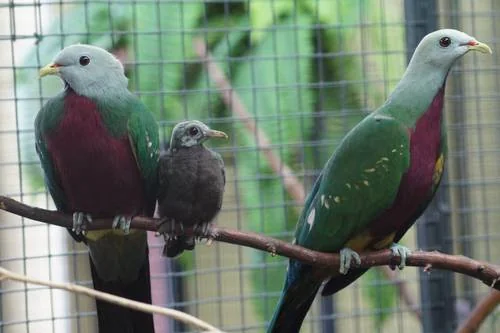
The Wompoo Fruit Dove (Megaloprepia magnifica) is one of the largest and most vividly coloured fruit doves. Its purple breast, yellow belly, green upperparts and pale wing-bar define its appearance. It occurs in New Guinea and offshore islands and in eastern Australia. The project stock is small and still being developed.
- Distribution
- New Guinea and several offshore island groups, and eastern Australia from Cape York Peninsula to eastern New South Wales.
- Size / characteristics
- about 29–45 cm | grey head, green upperparts, pale wing-bar, purple breast and yellow lower belly | sexes externally similar; regional forms differ markedly in size
- Status
- Project stock small and still being developed; breeding is challenging
Description
The Wompoo Fruit Dove is a large, robust forest pigeon. Typical features include a grey head, green upperparts, a pale wing-bar and a rich purple breast grading into a yellow lower belly. Males and females are externally similar. Regional populations differ strongly in size and plumage; five subspecies are used in the AviList concept applied here, although other checklists divide some New Guinea populations more finely. The small project stock requires careful documentation of origin and subspecies.
Profile & short facts for Wompoo Fruit Dove
| English name | Wompoo Fruit Dove |
|---|---|
| German name | Purpurbrust-Fruchttaube |
| Scientific name | Megaloprepia magnifica |
| Genus | Megaloprepia |
| Category | Fruit doves of other genera |
| Distribution | New Guinea and several offshore island groups, and eastern Australia from Cape York Peninsula to eastern New South Wales. |
| Subspecies | Five subspecies in the AviList concept used here: M. m. magnifica, M. m. puella, M. m. poliura, M. m. assimilis and M. m. keri. Other checklists treat some New Guinea populations differently. |
| Size / characteristics | about 29–45 cm | grey head, green upperparts, pale wing-bar, purple breast and yellow lower belly | sexes externally similar; regional forms differ markedly in size |
| Status | Project stock small and still being developed; breeding is challenging |
| Synonyms | Ptilinopus magnificus |
Habitat and natural range
Tropical and subtropical rainforest, moist gallery forest, forest edges and mature secondary woodland.
Feeding in the European Fruit Dove Project
The species feeds mainly on fruit and berries and can swallow relatively large forest fruits whole because of its large bill. In human care, a varied fruit ration should be combined with a balanced complementary food for frugivorous pigeons. Body weight, condition and food intake should be monitored regularly in this large species.
Husbandry in the European Fruit Dove Project
This large and powerful fruit dove requires a particularly spacious, well-structured and permanently frost-free aviary with long open flight paths, stable elevated perches and generously sized feeding stations. Multiple retreat and escape areas help reduce competition. Origin and subspecies should be clarified before pairs are formed.
Breeding and offspring
Quiet, elevated and particularly load-bearing nest sites with sturdy twig material are required. As the project stock is small and breeding is considered challenging, pair formation, subspecies, pedigree, laying, hatching and rearing should be documented completely.
Subspecies and systematics
Five subspecies in the AviList concept used here: M. m. magnifica, M. m. puella, M. m. poliura, M. m. assimilis and M. m. keri. Other checklists treat some New Guinea populations differently.
Special notes on the species
The common name reflects the characteristic call, often rendered as “wom-poo”. Northern Australian forms are distinctly smaller than the more southerly nominate form.
Conservation status
| IUCN | Least Concern |
|---|---|
| CITES | Not listed |
| EU species protection | Not listed |
| Ring size | 7,0 mm |
Further sources
Images of the Wompoo Fruit Dove
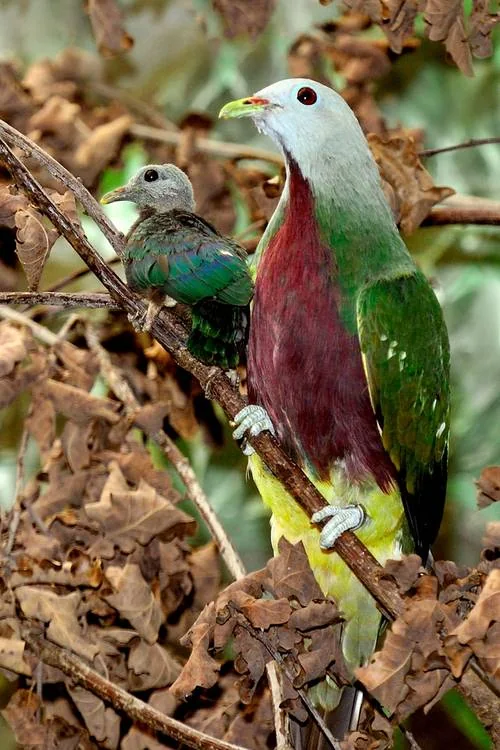
Image credits
- Purpurbrust-Fruchttaube mit Jungtier (© Thomas Breuer)
- Purpurbrust-Fruchttaube mit Jungvogel im Zoo Köln (© Thomas Breuer)
- Purpurbrust-Fruchttaube im Zoo Köln (© Thomas Breuer)