Fruit dove profile
White-eared Brown Dove (Phapitreron leucotis)
Species at a glance
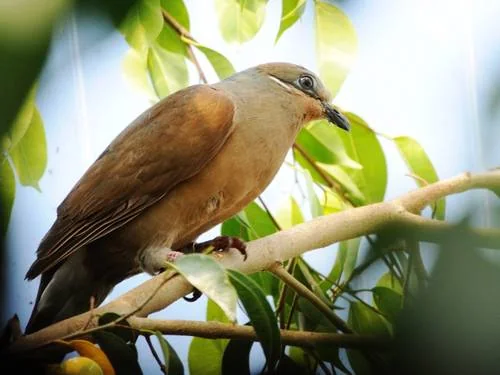
The White-eared Brown Dove (Phapitreron leucotis) is a medium-sized forest pigeon endemic to the Philippines. A pale stripe behind the eye and darker bordering marks contrast with the warm brown plumage. Four subspecies are recognised. The stock within the European Fruit Dove Project is small.
- Distribution
- The Philippines, excluding the Palawan island group.
- Size / characteristics
- about 24 cm | warm brown to bronze plumage, pale stripe behind the eye and darker head markings, with some metallic neck gloss | sexes externally very similar
- Status
- Project stock small
Description
The White-eared Brown Dove is a subtly but finely patterned Philippine brown dove. It is characterised by warm brown to bronze plumage, a pale stripe behind the eye and a darker border below it; the neck may show greenish to violet iridescence. Males and females are externally very similar. Four subspecies are distributed across Luzon, the central Philippines, Mindanao and the Sulu Archipelago. The small project stock should be managed carefully by origin, subspecies and pedigree.
Profile & short facts for White-eared Brown Dove
| English name | White-eared Brown Dove |
|---|---|
| German name | Ohrstreiftaube |
| Scientific name | Phapitreron leucotis |
| Genus | Phapitreron |
| Category | Fruit doves of other genera |
| Distribution | The Philippines, excluding the Palawan island group. |
| Subspecies | Phapitreron l. leucotis – northern Philippines including Luzon, Catanduanes and Mindoro with satellite islands | P. l. nigrorum – Cebu, Guimaras, Masbate, Negros and Panay with satellite islands | P. l. brevirostris – Leyte, Bohol, Dinagat, Samar, Mindanao, Siquijor and other southeastern islands | P. l. occipitalis – Basilan and the Sulu Archipelago. |
| Size / characteristics | about 24 cm | warm brown to bronze plumage, pale stripe behind the eye and darker head markings, with some metallic neck gloss | sexes externally very similar |
| Status | Project stock small |
Habitat and natural range
Lowland and hill forest, forest edges, mature secondary woodland, scrub and wooded agricultural landscapes.
Feeding in the European Fruit Dove Project
The species feeds mainly on fruit and berries and takes food in trees, shrubs and occasionally lower vegetation. In human care, a varied fruit ration should be combined with a balanced complementary food for frugivorous pigeons. Food intake and condition should be monitored regularly in a small stock.
Husbandry in the European Fruit Dove Project
This calm forest pigeon requires a spacious, densely structured and permanently frost-free aviary with open flight paths, stable elevated perches and protected retreat areas. Multiple feeding sites and visual screening help limit competition and disturbance.
Breeding and offspring
Quiet, elevated and well-screened nest sites with suitable twig material should be offered. In the small project stock, subspecies, origin, pair formation, pedigree, hatching and juvenile development must be documented completely.
Subspecies and systematics
Phapitreron l. leucotis – northern Philippines including Luzon, Catanduanes and Mindoro with satellite islands | P. l. nigrorum – Cebu, Guimaras, Masbate, Negros and Panay with satellite islands | P. l. brevirostris – Leyte, Bohol, Dinagat, Samar, Mindanao, Siquijor and other southeastern islands | P. l. occipitalis – Basilan and the Sulu Archipelago.
Special notes on the species
The pale ear stripe gives the species its English and German names. In favourable light, the subtle plumage shows greenish to violet iridescence on the neck.
Conservation status
| IUCN | Least Concern |
|---|---|
| CITES | Not listed |
| EU species protection | Not listed |
| Ring size | 6,0 mm |
Further sources
Images of the White-eared Brown Dove
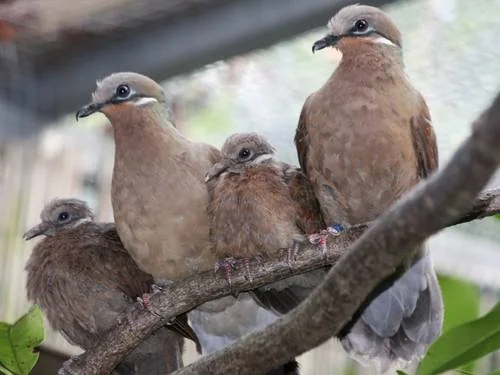
Image credits
- Ohrstreiftauben-Paar mit Jungvögeln (© Florence Velez)
- Ohrstreiftaube bei Manfred Kästner (© Johannes Pfleiderer)
- Ohrstreiftauben bei Manfred Kästner (© Johannes Pfleiderer)