Fruit dove profile
Orange-fronted Fruit Dove (Ptilinopus aurantiifrons)
Species at a glance
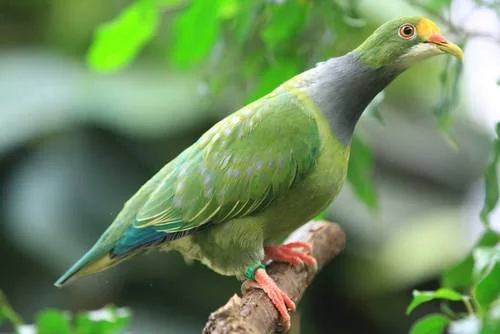
The Orange-fronted Fruit Dove (Ptilinopus aurantiifrons) is a small to medium-sized, predominantly green fruit dove with a conspicuous orange-yellow forehead. It occurs across much of New Guinea and on Raja Ampat, Yapen, the Aru Islands and the D'Entrecasteaux Archipelago. The stock within the European Fruit Dove Project is very small.
- Distribution
- Much of New Guinea, together with the Raja Ampat Islands, Aru Islands, Yapen and the D'Entrecasteaux Archipelago.
- Size / characteristics
- about 22–23 cm | predominantly green plumage and bright orange-yellow frontal patch; female usually duller | sexes distinguishable, though differences may be subtle
- Status
- Project stock very small
Description
The Orange-fronted Fruit Dove is readily identified by its bright orange-yellow frontal patch. The remaining plumage is mainly green with paler underparts and differences in intensity between the sexes; the female is usually duller. The species is not confined to a narrow coastal strip but occurs across much of lowland New Guinea and several offshore island groups. It is monotypic. Because the project stock is very small, origin, pair formation and every breeding result require particularly careful documentation.
Profile & short facts for Orange-fronted Fruit Dove
| English name | Orange-fronted Fruit Dove |
|---|---|
| German name | Goldstirn-Fruchttaube |
| Scientific name | Ptilinopus aurantiifrons |
| Genus | Ptilinopus |
| Category | Ptilinopus - fruit doves |
| Distribution | Much of New Guinea, together with the Raja Ampat Islands, Aru Islands, Yapen and the D'Entrecasteaux Archipelago. |
| Subspecies | Monotypic; no subspecies are currently widely recognised. |
| Size / characteristics | about 22–23 cm | predominantly green plumage and bright orange-yellow frontal patch; female usually duller | sexes distinguishable, though differences may be subtle |
| Status | Project stock very small |
Habitat and natural range
Tropical lowland and swamp forest, gallery forest, forest edges, mature secondary woodland and wooded transition zones.
Feeding in the European Fruit Dove Project
The species feeds mainly on small fruits, berries and figs taken from trees and shrubs. In human care, a varied selection of suitably small fruits should be combined with a balanced complementary food for frugivorous pigeons. Food pieces and feeding sites must suit the smaller body size.
Husbandry in the European Fruit Dove Project
This active and disturbance-sensitive species requires a spacious, densely planted and permanently frost-free aviary with short open flight paths, fine perches and protected retreat areas. Calm routines, several feeding sites and visual screening are especially important in a very small stock.
Breeding and offspring
Well-screened elevated nesting baskets or small platforms with fine twig material should be provided. Unnecessary nest inspections should be avoided. As the project stock is very small, pair formation, laying, hatching and juvenile development must be documented completely.
Subspecies and systematics
Monotypic; no subspecies are currently widely recognised.
Special notes on the species
The bright frontal patch gives the species its common names. Despite its vivid colour, it can be difficult to detect among green foliage in the canopy.
Conservation status
| IUCN | Least Concern |
|---|---|
| CITES | Not listed |
| EU species protection | Not listed |
| Ring size | 7,0 mm |
Further sources
Images of the Orange-fronted Fruit Dove
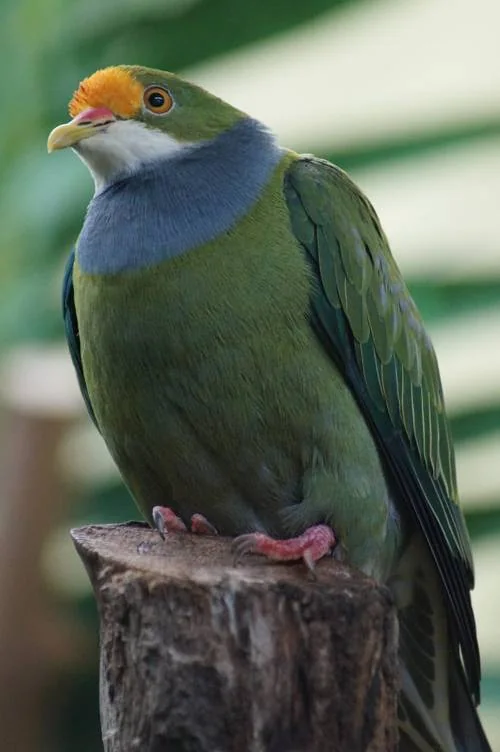
Image credits
Goldstirn-Fruchttaube im Zoo Köln (© Thomas Breuer)