Fruit dove profile
Red-bellied Fruit Dove (Ptilinopus greyii)
Species at a glance
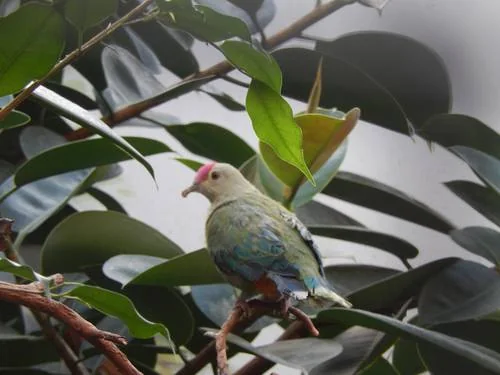
The Red-bellied Fruit Dove (Ptilinopus greyi) is a small, predominantly green fruit dove of the southwest Pacific. It is characterised by a pale head and a red to purplish breast or belly patch, usually weaker in the female. The stock within the European Fruit Dove Project is still being developed.
- Distribution
- Islands in the southern and southeastern Solomon Islands including Temotu, Vanuatu, and New Caledonia including the Loyalty Islands and Île des Pins.
- Size / characteristics
- about 21–24 cm | predominantly green plumage, pale head and red to purplish belly patch | female usually duller with a weaker belly patch
- Status
- Project stock being developed
Description
The Red-bellied Fruit Dove occupies a widely scattered island range from parts of the Solomon Islands through Vanuatu to New Caledonia. The plumage is mainly green, with a paler head and neck and a red to purplish belly patch providing the strongest contrast. Males and females are similar, although females are often duller and show a smaller or weaker belly patch. The species is monotypic. The current scientific spelling is Ptilinopus greyi; the form Ptilinopus greyii still stored in the project is outdated.
Profile & short facts for Red-bellied Fruit Dove
| English name | Red-bellied Fruit Dove |
|---|---|
| German name | Greyfruchttaube |
| Scientific name | Ptilinopus greyii |
| Genus | Ptilinopus |
| Category | Ptilinopus - fruit doves |
| Distribution | Islands in the southern and southeastern Solomon Islands including Temotu, Vanuatu, and New Caledonia including the Loyalty Islands and Île des Pins. |
| Subspecies | Monotypic; no subspecies are currently widely recognised. |
| Size / characteristics | about 21–24 cm | predominantly green plumage, pale head and red to purplish belly patch | female usually duller with a weaker belly patch |
| Status | Project stock being developed |
Habitat and natural range
Moist lowland and island forest, forest edges, mature secondary growth, coastal scrub and wooded cultivated landscapes.
Feeding in the European Fruit Dove Project
The species feeds mainly on small fruits, berries and figs taken from trees and shrubs. In human care, a varied selection of suitably small fruits should be combined with a balanced complementary food for frugivorous pigeons. Multiple feeding sites help limit competition.
Husbandry in the European Fruit Dove Project
This small and active species requires a spacious, densely planted and permanently frost-free aviary with short open flight paths, fine perches and protected retreat areas. Calm routines, visual screening and several feeding sites are especially important in a developing stock.
Breeding and offspring
Well-protected elevated nesting baskets or small platforms with fine twig material should be offered. Unnecessary nest inspections should be avoided. Pair formation, laying, hatching and juvenile development should be documented completely.
Subspecies and systematics
Monotypic; no subspecies are currently widely recognised.
Special notes on the species
The project record still uses the outdated spelling Ptilinopus greyii. Current world lists use Ptilinopus greyi.
Conservation status
| IUCN | Least Concern |
|---|---|
| CITES | Not listed |
| EU species protection | Not listed |
| Ring size | 6,0 mm |
Further sources
Images of the Red-bellied Fruit Dove
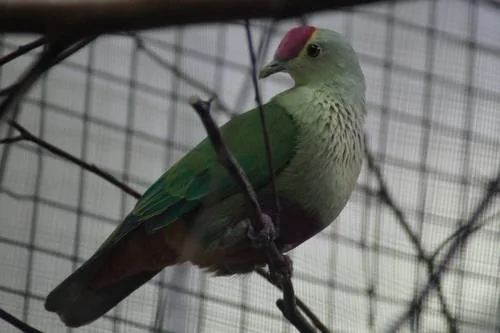
Image credits
Greyfruchttaube im Zoo Berlin (© Thomas Weiß)