Fruit dove profile
Ornate Fruit Dove (Ptilinopus ornatus)
Species at a glance
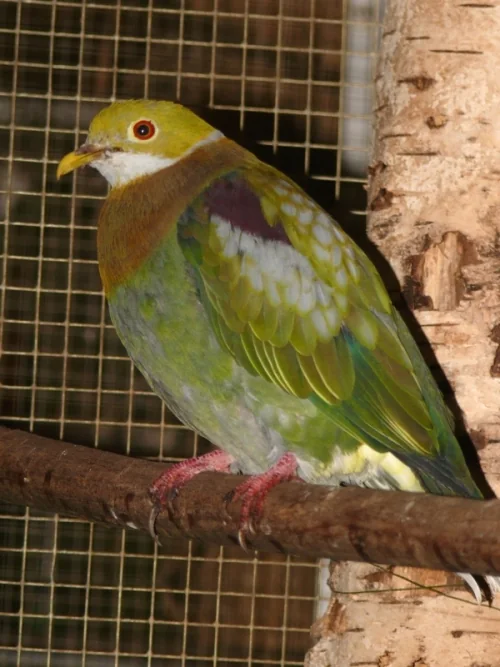
The Ornate Fruit Dove (Ptilinopus ornatus) is a large and strongly patterned fruit dove of New Guinea's hill and montane forests. Depending on subspecies, it has a wine-red or yellowish-olive crown and conspicuous shoulder markings. The species is currently not represented within the European Fruit Dove Project.
- Distribution
- New Guinea, especially hill and mountain regions of the Bird's Head and central and eastern parts of the island.
- Size / characteristics
- about 25 cm | depending on subspecies, a wine-red or yellowish-olive crown, grey neck, bronze breast and conspicuous silvery-blue and dark shoulder areas | sexes externally similar
- Status
- Currently not represented in the project stock
Description
The Ornate Fruit Dove is a robust Ptilinopus species with complex plumage. The crown, neck, breast and wing coverts show combinations of wine-red, grey, bronze and silvery-blue depending on subspecies. Males and females are externally similar. Two subspecies occupy northwestern and central-eastern New Guinea. The species mainly inhabits hill and montane forest and may move seasonally between elevations. As it is not currently held within the project, husbandry and breeding information is presented as general specialist guidance rather than current project experience.
Profile & short facts for Ornate Fruit Dove
| English name | Ornate Fruit Dove |
|---|---|
| German name | Schmuckfruchttaube |
| Scientific name | Ptilinopus ornatus |
| Genus | Ptilinopus |
| Category | Ptilinopus - fruit doves |
| Distribution | New Guinea, especially hill and mountain regions of the Bird's Head and central and eastern parts of the island. |
| Subspecies | Ptilinopus o. ornatus – northwestern New Guinea, especially the Bird's Head | P. o. gestroi – central and eastern New Guinea to the southeastern peninsula. |
| Size / characteristics | about 25 cm | depending on subspecies, a wine-red or yellowish-olive crown, grey neck, bronze breast and conspicuous silvery-blue and dark shoulder areas | sexes externally similar |
| Status | Currently not represented in the project stock |
Habitat and natural range
Primary and mature secondary hill and montane rainforest, mainly at middle elevations; seasonally also adjacent lower or higher forest zones.
Feeding in the European Fruit Dove Project
The species feeds mainly on small to medium-sized fruits and berries taken in the canopy. In human care, a varied selection of suitable fruits should be combined with a balanced complementary food for frugivorous pigeons. No current species-specific project data are available.
Husbandry in the European Fruit Dove Project
This large and disturbance-sensitive forest pigeon requires a spacious, densely structured and permanently frost-free aviary with longer open flight paths, stable elevated perches and protected retreat areas. Its montane origin must not be interpreted as general tolerance of cold housing.
Breeding and offspring
Quiet, elevated and well-screened nest sites with sturdy twig material should be provided in any prospective holding. As there are no current project birds, reliable project-specific data on pair formation, incubation and juvenile development are unavailable.
Subspecies and systematics
Ptilinopus o. ornatus – northwestern New Guinea, especially the Bird's Head | P. o. gestroi – central and eastern New Guinea to the southeastern peninsula.
Special notes on the species
The two subspecies differ especially in crown colour. According to existing project records, the last known European specimen associated with the project died in 2009.
Conservation status
| IUCN | Least Concern |
|---|---|
| CITES | Not listed |
| EU species protection | Not listed |
| Ring size | 7,0 mm |
Further sources
Images of the Ornate Fruit Dove
Image credits
Schmuckfruchttaube - Unterart gestroi - im Zoo Pilsen (© Johannes Pfleiderer)