Fruit dove profile
Black-chinned Fruit Dove (Ramphiculus leclancheri)
Species at a glance
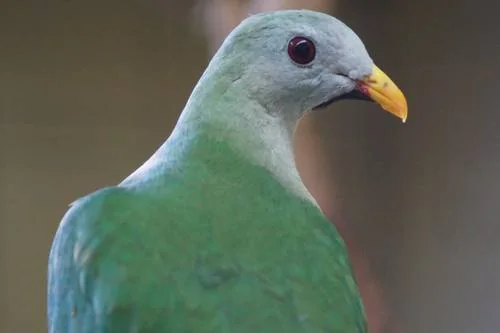
The Black-chinned Fruit Dove (Ramphiculus leclancheri) is a medium-sized, vividly coloured fruit dove of the Philippines and Taiwan. The male has a small black chin patch, pale grey head and green body areas, while the female is predominantly green. The project stock is small, still developing and has a marked surplus of females.
- Distribution
- Taiwan and Lanyu, and much of the Philippines including Palawan but excluding Basilan and the Sulu Archipelago.
- Size / characteristics
- about 26–28 cm | male with pale grey head, violet transition, small black chin patch and green body areas; female predominantly green | pronounced sexual dimorphism
- Status
- Project stock small and still developing; marked surplus of females
Description
The Black-chinned Fruit Dove shows pronounced sexual dimorphism. In the male, a pale grey head and neck, violet transition, the namesake black chin patch and green wings and underparts form a strong contrast. The female is greener and less contrasting overall. Four subspecies occur across Taiwan, Lanyu and much of the Philippines including Palawan. Current world lists place the species in the genus Ramphiculus. The small and unbalanced project stock requires coordinated pair formation and accurate subspecies documentation.
Profile & short facts for Black-chinned Fruit Dove
| English name | Black-chinned Fruit Dove |
|---|---|
| German name | Schwarzkinn-Fruchttaube |
| Scientific name | Ramphiculus leclancheri |
| Genus | Ramphiculus |
| Category | Ptilinopus - fruit doves |
| Distribution | Taiwan and Lanyu, and much of the Philippines including Palawan but excluding Basilan and the Sulu Archipelago. |
| Subspecies | Ramphiculus l. leclancheri – Philippines outside Palawan, Basilan and the Sulu Archipelago | R. l. longialis – Lanyu and Batan, Calayan and Camiguin Norte | R. l. taiwanus – Taiwan | R. l. gironieri – Palawan and the Calamian Islands. |
| Size / characteristics | about 26–28 cm | male with pale grey head, violet transition, small black chin patch and green body areas; female predominantly green | pronounced sexual dimorphism |
| Status | Project stock small and still developing; marked surplus of females |
| Synonyms | Ptilinopus leclancheri |
Habitat and natural range
Lowland and hill forest, forest edges, mature secondary woodland and wooded cultivated landscapes.
Feeding in the European Fruit Dove Project
The species feeds mainly on fruit and berries taken from trees and shrubs. In human care, a varied selection of suitable fruits should be combined with a balanced complementary food for frugivorous pigeons. Food intake, body weight and condition should be documented regularly in the small stock.
Husbandry in the European Fruit Dove Project
This rather calm but disturbance-sensitive species requires a spacious, densely structured and permanently frost-free aviary with open flight paths, a mixture of fine and sturdy perches, and protected retreat areas. Multiple feeding sites and visual screening help limit competition and disturbance.
Breeding and offspring
Quiet, well-screened and elevated nest sites with suitable twig material should be offered. Because of the small stock and surplus of females, subspecies, origin, pair formation, pedigree, laying, hatching and juvenile development must be documented completely.
Subspecies and systematics
Ramphiculus l. leclancheri – Philippines outside Palawan, Basilan and the Sulu Archipelago | R. l. longialis – Lanyu and Batan, Calayan and Camiguin Norte | R. l. taiwanus – Taiwan | R. l. gironieri – Palawan and the Calamian Islands.
Special notes on the species
The male's small black chin patch gives the species its common name. Four geographically separated subspecies require careful origin records.
Conservation status
| IUCN | Least Concern |
|---|---|
| CITES | Not listed |
| EU species protection | Not listed |
| Ring size | 7,0 mm |
Further sources
Images of the Black-chinned Fruit Dove
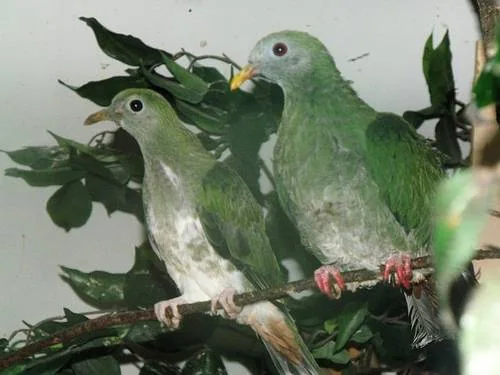
Image credits
- Schwarzkinn-Fruchttaube mit halbwüchsigem Jungvogel (© Jens Riebe)
- Schwarzkinn-Fruchttauben (© Christian Zenker)
- Schwarzkinn-Fruchttaube (© Thomas Breuer)
- Halbwüchsige Schwarzkinn-Fruchttaube (© Jens Riebe)
- Junge Schwarzkinn-Fruchttaube - die erste innerhalb des Projekts nachgezogene (© Jens Riebe)
- Schwarzkinn-Fruchttaube mit Jungvogel (© Jens Riebe)