Fruit dove profile
Flame-breasted Fruit Dove (Ramphiculus marchei)
Species at a glance
The Flame-breasted Fruit Dove (Ramphiculus marchei) is a large, vividly coloured fruit dove endemic to Luzon. It mainly inhabits montane and cloud forest and is globally classified as Near Threatened. The stock within the European Fruit Dove Project is still being developed and is very small.
- Distribution
- Luzon in the northern Philippines.
- Size / characteristics
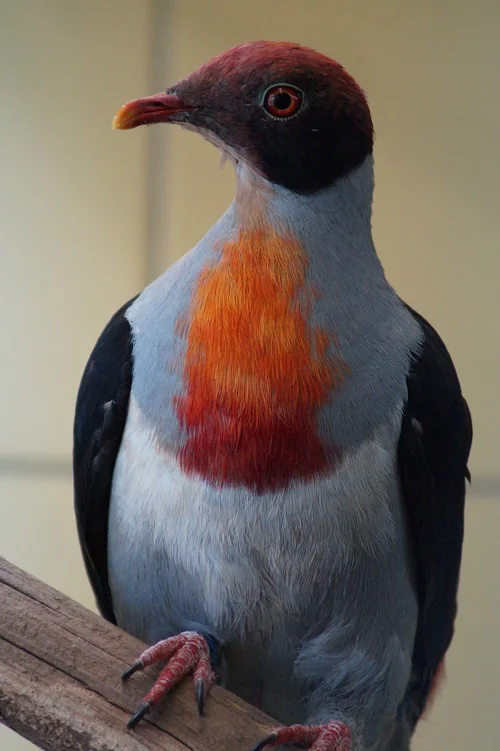
- about 35–40 cm | male with grey head, dark ear region, green upperparts and rich orange to flame-coloured breast; female greener and less contrasting
- Status
- Stock still being developed and very small
Description
The Flame-breasted Fruit Dove is a distinctive Philippine island species. The male combines a grey head, dark ear region, green upperparts and a rich orange to flame-coloured breast, while the female is greener and less contrasting overall. The species occurs only on Luzon and is associated with forested mountain regions. Habitat loss and hunting pressure are relevant to its population trend. Because the project stock is very small, origin, sex, pair formation and every breeding result require particularly careful documentation.
Profile & short facts for Flame-breasted Fruit Dove
| English name | Flame-breasted Fruit Dove |
|---|---|
| German name | Blutschwingen-Fruchttaube |
| Scientific name | Ramphiculus marchei |
| Genus | Ramphiculus |
| Category | Ptilinopus - fruit doves |
| Distribution | Luzon in the northern Philippines. |
| Subspecies | Monotypic; no subspecies are currently widely recognised. |
| Size / characteristics | about 35–40 cm | male with grey head, dark ear region, green upperparts and rich orange to flame-coloured breast; female greener and less contrasting |
| Status | Stock still being developed and very small |
| Synonyms | Ptilinopus marchei |
Habitat and natural range
Primary and mature secondary montane and cloud forest on Luzon, mainly at middle and higher elevations.
Feeding in the European Fruit Dove Project
The species feeds mainly on fruit and berries taken in trees. In human care, a varied selection of suitable fruits should be combined with a balanced complementary food for frugivorous pigeons. In a very small stock, food intake, body weight and condition require close monitoring.
Husbandry in the European Fruit Dove Project
This large but disturbance-sensitive forest pigeon requires a spacious, densely structured and permanently frost-free aviary with open flight paths, a mixture of fine and sturdy branches, and protected retreat areas. Disturbance, frequent intervention and competition at feeding sites should be minimised.
Breeding and offspring
Quiet, elevated and well-screened nest sites with suitable twig material should be provided. The very small developing stock requires controlled pair selection and complete documentation of pedigree, laying, hatching and juvenile development. Unverified general timing values are not used.
Subspecies and systematics
Monotypic; no subspecies are currently widely recognised.
Special notes on the species
The species is restricted to Luzon and shows clear sexual dimorphism. Its current Near Threatened classification highlights the value of reliable population records.
Conservation status
| IUCN | Near Threatened |
|---|---|
| CITES | Not listed |
| EU species protection | Not listed |
| Ring size | 9,0 mm |
Further sources
Images of the Flame-breasted Fruit Dove
Image credits
Blutschwingen-Fruchttaube (©Thomas Breuer )