Fruit dove profile
Pink-necked Green Pigeon (Treron vernans)
Species at a glance
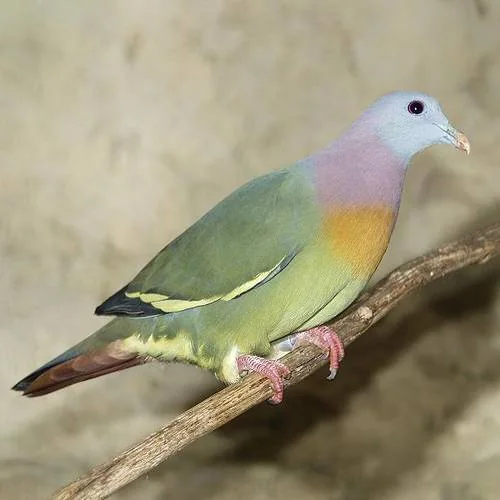
The Pink-necked Green Pigeon (Treron vernans) is a medium-sized Southeast Asian green pigeon with pronounced sexual dimorphism. The male combines a pink neck, orange breast and green plumage, while the female is predominantly green. The stock within the European Fruit Dove Project is secure and breeds regularly.
- Distribution
- From Myanmar, Thailand, Cambodia and Vietnam through the Malay Peninsula to Sumatra, Borneo, Java, the Lesser Sundas and the Philippines.
- Size / characteristics
- about 23.5–30 cm | male with grey head, pink neck, orange breast and green body; female predominantly green with yellowish underparts | pronounced sexual dimorphism
- Status
- Project stock secure; bred regularly
Description
The Pink-necked Green Pigeon is widespread in Southeast Asia and occurs in forest, mangroves, plantations, parks and cities with fruiting trees. The male's pink neck and orange breast clearly distinguish it from the mostly green female. The diet frequently includes figs, and the species contributes to seed dispersal. Several subspecies are recognised. The secure project stock provides a sound basis for long-term documentation of breeding results, lineages and husbandry observations.
Profile & short facts for Pink-necked Green Pigeon
| English name | Pink-necked Green Pigeon |
|---|---|
| German name | Frühlingsgrüntaube |
| Scientific name | Treron vernans |
| Genus | Treron |
| Category | Treron - green pigeons |
| Distribution | From Myanmar, Thailand, Cambodia and Vietnam through the Malay Peninsula to Sumatra, Borneo, Java, the Lesser Sundas and the Philippines. |
| Subspecies | Five recognised subspecies: Treron v. vernans, T. v. adinus, T. v. kangeanus, T. v. karimuniensis and T. v. miza. |
| Size / characteristics | about 23.5–30 cm | male with grey head, pink neck, orange breast and green body; female predominantly green with yellowish underparts | pronounced sexual dimorphism |
| Status | Project stock secure; bred regularly |
Habitat and natural range
Lowland forest, mangroves, forest edges, secondary growth, plantations, parks and urban green spaces with fruiting trees.
Feeding in the European Fruit Dove Project
The species feeds mainly on fruit, especially figs and other small to medium-sized tree fruits. In human care, a varied selection of suitable fruits should be combined with a balanced complementary food for frugivorous pigeons. Multiple feeding sites facilitate the management of small groups.
Husbandry in the European Fruit Dove Project
This agile and social green pigeon requires a spacious, densely branched and permanently frost-free aviary with open flight paths, perches of different thicknesses and protected retreat areas. Group and pair behaviour and competition at feeding and nesting sites require close observation.
Breeding and offspring
The species builds a loose twig nest and normally lays two eggs. Quiet, well-screened nesting options in shrubs or elevated planted areas are appropriate. In the secure project stock, pairings, hatching, rearing and pedigree should continue to be documented consistently.
Subspecies and systematics
Five recognised subspecies: Treron v. vernans, T. v. adinus, T. v. kangeanus, T. v. karimuniensis and T. v. miza.
Special notes on the species
The strong colour difference between the sexes makes the species readily identifiable. It adapts comparatively well to human-modified landscapes where sufficient fruiting trees remain.
Conservation status
| IUCN | Least Concern |
|---|---|
| CITES | Not listed |
| EU species protection | Not listed |
| Ring size | 7,0–8,0 mm |
Further sources
Images of the Pink-necked Green Pigeon
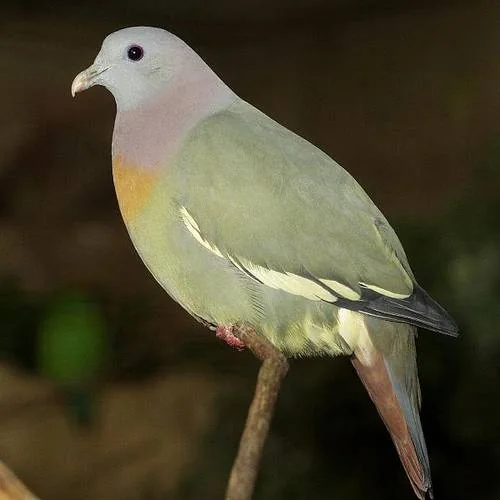
Image credits
Frühlingstaube (© Vogelpark Walsrode)