Fruit dove profile
Green Imperial Pigeon (Ducula aenea)
Species at a glance
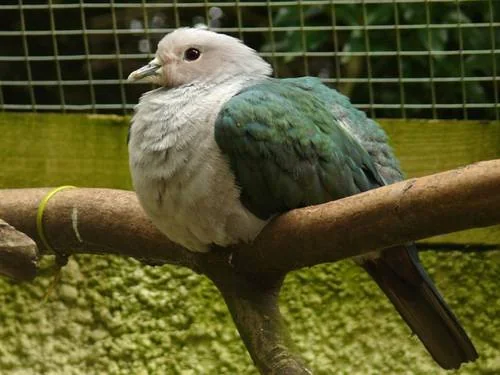
The Green Imperial Pigeon (Ducula aenea) is a large Asian forest pigeon with a pale grey head and underparts and metallic green to bronze upperparts. Its range extends from India and Sri Lanka through Southeast Asia to Indonesia and the Philippines. The stock within the European Fruit Dove Project is still very small and being developed.
- Distribution
- From India and Sri Lanka through Myanmar, southern China and Indochina to the Malay Peninsula; also the Andaman Islands, Sumatra, Java, Borneo, the Lesser Sundas, the Philippines, Sulawesi and several offshore island groups.
- Size / characteristics
- about 40–47 cm | pale grey head and underparts, metallic green to bronze-glossed upperparts and chestnut undertail coverts | sexes externally similar
- Status
- Stock still being developed and very small
Description
The Green Imperial Pigeon is one of the more widely distributed large imperial pigeons of Asia. Typical features include the pale grey head and underparts, dark green to bronze-glossed wings and chestnut undertail coverts. Males and females are externally very similar. The species is currently divided into eleven subspecies distributed across a broad and highly fragmented area from South Asia to the Philippines and Sulawesi. Its global conservation status has been raised to Near Threatened. Reliable origin, subspecies identity and the avoidance of uncontrolled mixing are therefore especially important for the very small project stock.
Profile & short facts for Green Imperial Pigeon
| English name | Green Imperial Pigeon |
|---|---|
| German name | Bronzefruchttaube |
| Scientific name | Ducula aenea |
| Genus | Ducula |
| Category | Ducula - imperial pigeons |
| Distribution | From India and Sri Lanka through Myanmar, southern China and Indochina to the Malay Peninsula; also the Andaman Islands, Sumatra, Java, Borneo, the Lesser Sundas, the Philippines, Sulawesi and several offshore island groups. |
| Subspecies | Eleven recognised subspecies: D. a. sylvatica, D. a. pusilla, D. a. andamanica, D. a. consobrina, D. a. polia, D. a. palawanensis, D. a. fugaensis, D. a. nuchalis, D. a. aenea, D. a. intermedia and D. a. paulina. |
| Size / characteristics | about 40–47 cm | pale grey head and underparts, metallic green to bronze-glossed upperparts and chestnut undertail coverts | sexes externally similar |
| Status | Stock still being developed and very small |
Habitat and natural range
Tropical and subtropical lowland and hill forest, mangroves, forest edges, mature secondary woodland and wooded cultivated landscapes.
Feeding in the European Fruit Dove Project
The species feeds mainly on fruit and berries and often swallows relatively large forest fruits whole. In human care, a varied fruit ration should be combined with a balanced complementary food for frugivorous pigeons. Food intake, body weight and condition should be documented regularly in such large birds.
Husbandry in the European Fruit Dove Project
This large and active canopy pigeon requires a spacious, well-structured and permanently frost-free aviary with long open flight paths, stable elevated perches and protected retreat areas. Multiple feeding and escape sites help limit competition. Birds of different or unresolved origin should not be combined without taxonomic and breeding review.
Breeding and offspring
Large imperial pigeons normally lay a single egg. Quiet, elevated and load-bearing nest sites with sturdy twig material should be provided. In the very small developing stock, subspecies, origin, pair formation, pedigree, hatching and juvenile development must be recorded completely.
Subspecies and systematics
Eleven recognised subspecies: D. a. sylvatica, D. a. pusilla, D. a. andamanica, D. a. consobrina, D. a. polia, D. a. palawanensis, D. a. fugaensis, D. a. nuchalis, D. a. aenea, D. a. intermedia and D. a. paulina.
Special notes on the species
The species comprises eleven regionally separated subspecies. In conservation breeding, reliable origin and subspecies records are more important than identification based on appearance alone.
Conservation status
| IUCN | Near Threatened |
|---|---|
| CITES | Not listed |
| EU species protection | Not listed |
| Ring size | 11,0 mm |
Further sources
Images of the Green Imperial Pigeon
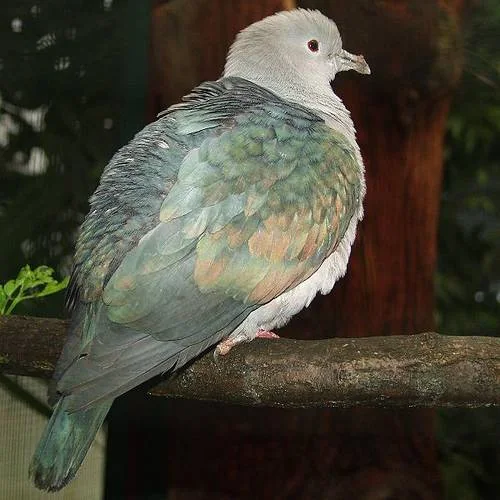
Image credits
- Bronzefruchttaube (© Vogelpark Walsrode)
- Bronzefruchttaube (© Johannes Pfleiderer)