Fruit dove profile
Pied Imperial Pigeon (Ducula bicolor)
Species at a glance
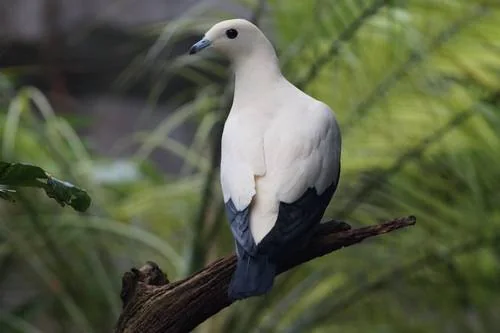
The Pied Imperial Pigeon (Ducula bicolor) is a large, predominantly white imperial pigeon with black flight feathers and a broad black terminal band on the tail. It occurs mainly in coastal forests, mangroves and wooded islands from Southeast Asia through the Philippines and Indonesia to western New Guinea. Its population within the European Fruit Dove Project is currently regarded as secure.
- Distribution
- From the Andaman Islands and mainland Southeast Asia through the Philippines and much of the Indonesian archipelago to the Raja Ampat Islands and the Bird's Head Peninsula of western New Guinea.
- Size / characteristics
- about 35–42 cm | predominantly white plumage; black flight feathers and a broad black terminal band on the tail | no reliable external sexual dimorphism
- Status
- Population secure within the project
Description
The Pied Imperial Pigeon is one of the most distinctive large imperial pigeons. The head, neck, underparts and much of the back are white to creamy white, while the flight feathers and broad terminal band of the tail are black. Males and females cannot be reliably distinguished by external appearance. The species is a powerful flyer and may cross considerable stretches of open water between roosting, breeding and feeding sites. As a fruit-eater, it contributes to seed dispersal in coastal and island forests. Its population within the European Fruit Dove Project is currently recorded as secure.
Profile & short facts for Pied Imperial Pigeon
| English name | Pied Imperial Pigeon |
|---|---|
| German name | Zweifarben-Fruchttaube |
| Scientific name | Ducula bicolor |
| Genus | Ducula |
| Category | Ducula - imperial pigeons |
| Distribution | From the Andaman Islands and mainland Southeast Asia through the Philippines and much of the Indonesian archipelago to the Raja Ampat Islands and the Bird's Head Peninsula of western New Guinea. |
| Subspecies | Two subspecies are commonly recognised: D. b. bicolor – the widespread nominate form; D. b. melanura – Moluccas, Tanimbar and Kai Islands. The taxonomic limits of melanura are treated differently by some authorities. |
| Size / characteristics | about 35–42 cm | predominantly white plumage; black flight feathers and a broad black terminal band on the tail | no reliable external sexual dimorphism |
| Status | Population secure within the project |
Habitat and natural range
Mainly coastal lowland forests, mangroves, forest edges, plantations and wooded islands; frequently in the canopy and on small offshore islands.
Feeding in the European Fruit Dove Project
The species feeds mainly on fruit and berries, including figs and other fleshy tree fruits, which are often swallowed whole. In human care, the diet should be varied and combine suitable fruits with a complementary feed formulated for frugivorous pigeons. Nutrient balance, mineral provision and iron content should be adjusted to the husbandry system, health status and veterinary guidance.
Husbandry in the European Fruit Dove Project
Large, powerful and highly active species requiring a spacious, well-structured aviary with long unobstructed flight paths, stable elevated perches and retreat areas. Housing must remain frost-free throughout the year; temperature management and shelter should be adapted to the local climate, group composition and condition of the birds. Social compatibility and stocking density require close observation.
Breeding and offspring
The species usually builds a simple platform nest of twigs in an elevated position. The clutch normally consists of a single egg, and both parents share incubation and chick care. Breeding requires quiet, stable and well-protected nest sites together with sturdy nesting material. Incubation and nestling periods may vary between holdings and should be recorded from documented project data.
Subspecies and systematics
Two subspecies are commonly recognised: D. b. bicolor – the widespread nominate form; D. b. melanura – Moluccas, Tanimbar and Kai Islands. The taxonomic limits of melanura are treated differently by some authorities.
Special notes on the species
The species may make long daily flights between islands and feeding areas and can gather there in large flocks. By swallowing whole fruits and later passing the seeds, it plays an important role in seed dispersal in coastal and island forests.
Conservation status
| IUCN | Least Concern |
|---|---|
| CITES | Not listed |
| EU species protection | Not listed |
| Ring size | 10,0 mm |
Further sources
Images of the Pied Imperial Pigeon
Image credits
- Zweifarben-Fruchttaube (© Thomas Breuer)
- Zweifarben-Fruchttauben (© Seth Martens)