Fruit dove profile
Torresian Imperial Pigeon (Ducula spilorrhoa)
Species at a glance
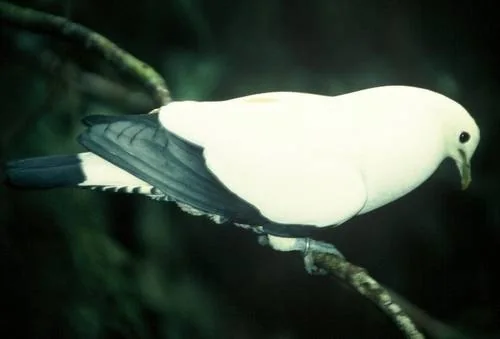
The Torresian Imperial Pigeon (Ducula spilorrhoa) is a large white to cream imperial pigeon with black flight feathers and dark spotting on the undertail coverts. It occurs in New Guinea, neighbouring islands and northern Australia. The stock within the European Fruit Dove Project is small.
- Distribution
- New Guinea including the Aru Islands and other neighbouring island groups, and northern Australia from the Kimberley region through the Northern Territory to eastern Queensland.
- Size / characteristics
- about 38–44 cm | around 380–550 g | white to cream plumage, black flight feathers and dark spotting on undertail coverts and thighs | sexes externally similar
- Status
- Project stock small
Description
The Torresian Imperial Pigeon belongs to the pied imperial pigeon complex but is now generally treated as a separate species. Its pale plumage contrasts strongly with the black flight feathers, while dark spots on the thighs and undertail coverts help distinguish it from similar species. Males and females are externally alike. In Australia, pronounced seasonal movements between the mainland, islands, breeding colonies and fruiting feeding areas are well documented. The small project stock should be managed with particular attention to origin and taxonomic identity.
Profile & short facts for Torresian Imperial Pigeon
| English name | Torresian Imperial Pigeon |
|---|---|
| German name | Kaiserfruchttaube |
| Scientific name | Ducula spilorrhoa |
| Genus | Ducula |
| Category | Ducula - imperial pigeons |
| Distribution | New Guinea including the Aru Islands and other neighbouring island groups, and northern Australia from the Kimberley region through the Northern Territory to eastern Queensland. |
| Subspecies | Monotypic in current international checklists. Taxonomic limits within the pied imperial pigeon complex have been treated differently in the past; Ducula subflavescens and several other regional forms are now generally recognised as separate species. |
| Size / characteristics | about 38–44 cm | around 380–550 g | white to cream plumage, black flight feathers and dark spotting on undertail coverts and thighs | sexes externally similar |
| Status | Project stock small |
Habitat and natural range
Coastal and lowland forest, mangroves, swamp forest, forest edges, wooded savanna, and regionally parks and gardens with fruiting trees.
Feeding in the European Fruit Dove Project
The species feeds almost entirely on fruit and can swallow fruits containing large seeds. It therefore plays an important role in seed dispersal between forest and island habitats. In human care, a varied fruit ration should be combined with suitable complementary food for frugivorous pigeons; several accessible feeding sites help reduce competition.
Husbandry in the European Fruit Dove Project
This powerful and sustained flyer requires ample usable flight space, stable elevated perches and protected resting areas. Housing must remain frost-free throughout the year and should provide several feeding and escape areas. In group housing, seasonal restlessness, pair formation and possible competition require close observation.
Breeding and offspring
In the wild, the species forms large regional breeding colonies on islands; each pair builds a simple twig nest and normally lays a single egg. Quiet, elevated and load-bearing nest sites should be provided in an aviary. Project data on pair compatibility, incubation, hatching and rearing should be recorded systematically without transferring values from wild populations uncritically.
Subspecies and systematics
Monotypic in current international checklists. Taxonomic limits within the pied imperial pigeon complex have been treated differently in the past; Ducula subflavescens and several other regional forms are now generally recognised as separate species.
Special notes on the species
The species makes substantial seasonal movements between islands, mainland areas and feeding sites. In northern Australia, large breeding and roosting aggregations may form.
Conservation status
| IUCN | Least Concern |
|---|---|
| CITES | Not listed |
| EU species protection | Not listed |
| Ring size | 11,0 mm |
Further sources
Images of the Torresian Imperial Pigeon
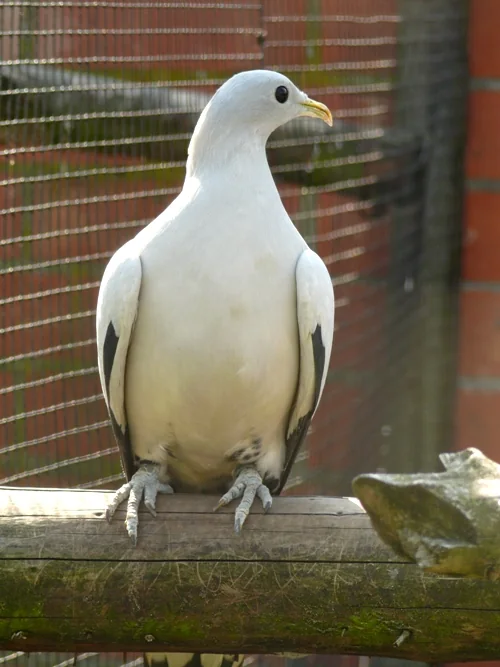
Image credits
- Kaiserfruchttaube (© Johannes Pfleiderer)
- Kopfansicht der Kaiserfruchttaube (© Johannes Pfleiderer)
- Färbung der Unterschwanzdecken von Kaiserfruchttaube (rechts) und Zweifarben-Fruchttaube (links) im Vergleich (© Seth Martens)
- Schnabelfärbung von Kaiserfruchttaube (rechts) und Zweifarben-Fruchttaube (links) im Vergleich (© Seth Martens)
- Kaiserfruchttaube (© Simon Bruslund)
- Unterschwanzdecken der Kaiserfruchttaube (© Johannes Pfleiderer)
- Vergleich Elster- (hinten) und Kaiserfruchttaube (vorne) (© Johannes Pfleiderer)
- Vergleich Elster- (links) und Kaiserfruchttaube (rechts) (© Johannes Pfleiderer)
- Vergleich der Unterschwanzdecken von Elster- (links) und Kaiserfruchttaube (rechts) (© Johannes Pfleiderer)