Fruit dove profile
Orange-bellied Fruit Dove (Ptilinopus iozonus)
Species at a glance
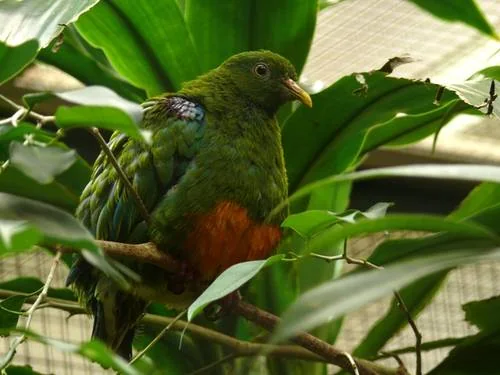
The Orange-bellied Fruit Dove (Ptilinopus iozonus) is a small, predominantly green fruit dove with a vivid orange patch on the lower breast and belly. It occurs in New Guinea and on several island groups to the west and south. The stock within the European Fruit Dove Project is small.
- Distribution
- New Guinea including Yapen, together with Raja Ampat, the Aru Islands and other western offshore islands.
- Size / characteristics
- about 20–22 cm | predominantly green plumage, round orange belly patch, small violet shoulder marking and pale tail tip | female usually duller and greyer on chin and head
- Status
- Project stock small
Description
The Orange-bellied Fruit Dove is readily recognised by its round vivid orange belly patch, green ground colour and small violet shoulder marking. Males and females are similar, although females are generally duller and greyer on the chin and head. Five subspecies occupy different parts of New Guinea, Raja Ampat and the Aru Islands. The species moves quickly through dense canopy vegetation. In the small project stock, origin, subspecies and breeding results should be documented carefully.
Profile & short facts for Orange-bellied Fruit Dove
| English name | Orange-bellied Fruit Dove |
|---|---|
| German name | Orangebauch-Fruchttaube |
| Scientific name | Ptilinopus iozonus |
| Genus | Ptilinopus |
| Category | Ptilinopus - fruit doves |
| Distribution | New Guinea including Yapen, together with Raja Ampat, the Aru Islands and other western offshore islands. |
| Subspecies | Ptilinopus i. iozonus – Aru Islands | P. i. humeralis – western Papuan islands and northwestern New Guinea | P. i. iobiensis – Yapen and northern New Guinea including neighbouring islands | P. i. pseudohumeralis – central southern New Guinea in the upper Fly River region | P. i. finschi – Huon Peninsula and southeastern New Guinea. |
| Size / characteristics | about 20–22 cm | predominantly green plumage, round orange belly patch, small violet shoulder marking and pale tail tip | female usually duller and greyer on chin and head |
| Status | Project stock small |
Habitat and natural range
Lowland rainforest, swamp and floodplain forest, gallery forest, forest edges and mature secondary woodland.
Feeding in the European Fruit Dove Project
The species feeds mainly on small fruits, berries and figs. In human care, a varied selection of suitably small fruits should be combined with a balanced complementary food for frugivorous pigeons. Feeding sites should be offered at different heights.
Husbandry in the European Fruit Dove Project
This highly active species requires a spacious, densely planted and permanently frost-free aviary with short open flight paths, fine perches and several protected retreat areas. Visual screening and multiple feeding sites help limit competition and disturbance.
Breeding and offspring
Quiet, well-screened nesting baskets or small elevated platforms with fine twig material should be offered. Unnecessary inspections should be avoided. In the small project stock, pair formation, subspecies, pedigree, hatching and juvenile development should be documented completely.
Subspecies and systematics
Ptilinopus i. iozonus – Aru Islands | P. i. humeralis – western Papuan islands and northwestern New Guinea | P. i. iobiensis – Yapen and northern New Guinea including neighbouring islands | P. i. pseudohumeralis – central southern New Guinea in the upper Fly River region | P. i. finschi – Huon Peninsula and southeastern New Guinea.
Special notes on the species
The vivid orange belly patch is unmistakable. The correct spelling of the northern subspecies is Ptilinopus iozonus iobiensis.
Conservation status
| IUCN | Least Concern |
|---|---|
| CITES | Not listed |
| EU species protection | Not listed |
| Ring size | 7,0 mm |
Further sources
Images of the Orange-bellied Fruit Dove
Image credits
Orangebauch-Fruchttaube (© Johannes Pfleiderer)