Fruit dove profile
Jambu Fruit Dove (Ramphiculus jambu (J. F. Gmelin, 1789))
Species at a glance
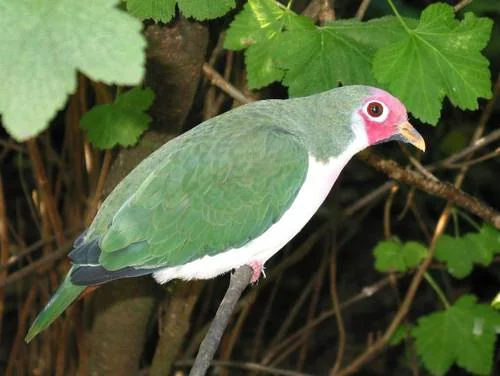
The Jambu Fruit Dove (Ramphiculus jambu) is a small, vividly coloured forest pigeon of Southeast Asia. The male combines a bright red face, pale underparts and green upperparts, while the female is predominantly green. The species is currently classified as Vulnerable, and the project stock remains very small.
- Distribution
- Southern Thailand, the Malay Peninsula, Sumatra, Borneo and western Java.
- Size / characteristics
- about 23–27 cm | male with bright red facial mask, whitish underparts and green upperparts; female predominantly green and much less contrasting | pronounced sexual dimorphism
- Status
- Stock still being developed and very small
Description
The Jambu Fruit Dove inhabits lowland forest and moist wooded landscapes of the Malay Peninsula, Sumatra, Borneo and western Java. Males have a conspicuous red facial mask and pale underparts, whereas females are much greener and less conspicuous. The species is monotypic. Habitat loss and continuing conversion of lowland forest have resulted in its current classification as Vulnerable. Current world lists place the species in the genus Ramphiculus; the project record still uses the former name Ptilinopus jambu.
Profile & short facts for Jambu Fruit Dove
| English name | Jambu Fruit Dove |
|---|---|
| German name | Jambu-Fruchttaube |
| Scientific name | Ramphiculus jambu (J. F. Gmelin, 1789) |
| Genus | Ramphiculus |
| Category | Fruit doves of other genera |
| Distribution | Southern Thailand, the Malay Peninsula, Sumatra, Borneo and western Java. |
| Subspecies | Monotypic; no subspecies are currently widely recognised. |
| Size / characteristics | about 23–27 cm | male with bright red facial mask, whitish underparts and green upperparts; female predominantly green and much less contrasting | pronounced sexual dimorphism |
| Status | Stock still being developed and very small |
| Synonyms | Ptilinopus jambu |
| Note | Die Art wurde in älteren Systematiken und noch in der IOC World Bird List v15.1 als Ptilinopus jambu geführt. Seit IOC v15.2 wird sie der Gattung Ramphiculus zugeordnet. Ptilinopus jambu wird als früher verwendete wissenschaftliche Kombination dokumentiert. |
Habitat and natural range
Moist lowland forest, peat-swamp and swamp forest, mangroves, mature secondary woodland and wooded cultivated landscapes.
Feeding in the European Fruit Dove Project
The species feeds mainly on small fruits, berries and figs. In human care, a varied selection of suitable fruits should be combined with a balanced complementary food for frugivorous pigeons. Food intake, body weight and condition require close monitoring in the very small stock.
Husbandry in the European Fruit Dove Project
This disturbance-sensitive species requires a spacious, densely planted and permanently frost-free aviary with short open flight paths, fine perches and protected retreat areas. Calm husbandry routines, visual screening and multiple feeding sites are especially important.
Breeding and offspring
Well-screened elevated nesting baskets or small platforms with fine twig material should be offered. Unnecessary nest inspections should be avoided. In the very small developing stock, pair formation, pedigree, laying, hatching and juvenile development must be documented completely.
Subspecies and systematics
Monotypic; no subspecies are currently widely recognised.
Special notes on the species
In 2025, current world lists transferred the species from Ptilinopus to Ramphiculus. The scientific name stored in the project requires a separate update.
Conservation status
| IUCN | Vulnerable |
|---|---|
| CITES | Not listed |
| EU species protection | Not listed |
| Ring size | 6,0–7,0 mm |
Further sources
Images of the Jambu Fruit Dove
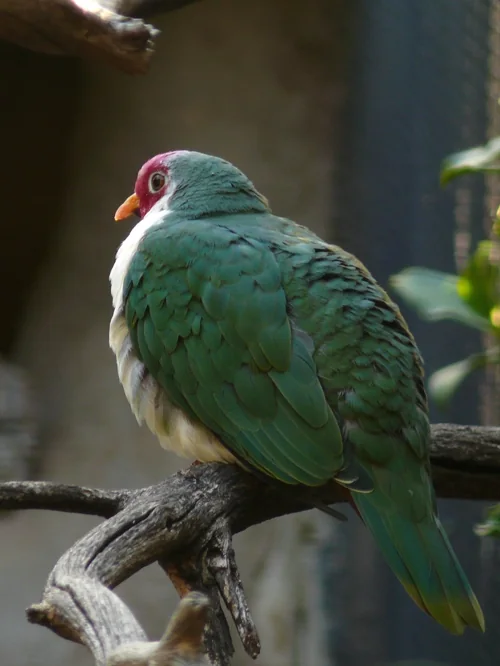
Image credits
- Jambu-Fruchttaube (© Johannes Pfleiderer)
- Jambu-Fruchttaube (© Manfred Brunkhorst)