Fruit dove profile
Black-naped Fruit Dove (Ptilinopus melanospilus)
Species at a glance
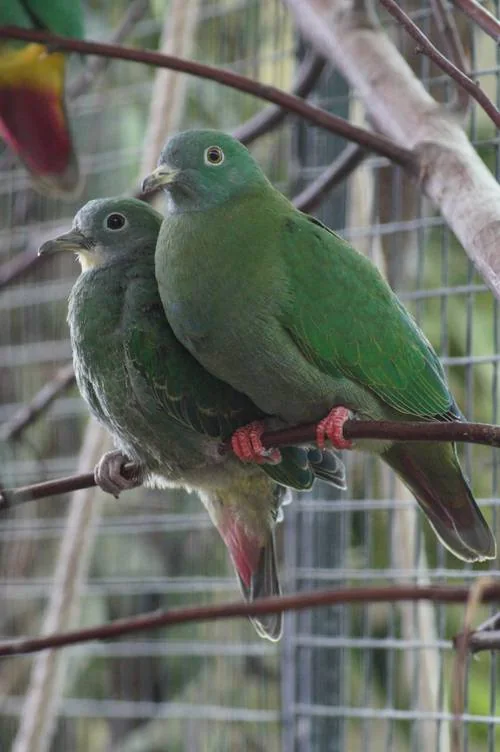
The Black-naped Fruit Dove (Ptilinopus melanospilus) is a small Southeast Asian fruit dove with pronounced sexual dimorphism. The male has a black nape and hindcrown and a yellowish throat, while the female is predominantly green. The project stock is secure and bred regularly.
- Distribution
- The Philippines, Sulawesi and neighbouring islands, and the Greater and Lesser Sunda Islands.
- Size / characteristics
- about 23–24 cm | male with black hindcrown and nape, grey head areas and yellowish throat; female predominantly green | pronounced sexual dimorphism
- Status
- Project stock secure and bred regularly
Description
The Black-naped Fruit Dove has a broad but highly fragmented island distribution from the Philippines through Sulawesi to the Sunda Islands. The male is readily identified by its black hindcrown and nape, grey head areas and yellowish throat; females are much more uniformly green. Six subspecies are recognised in current checklists. The species uses forest, forest edges, secondary growth and wooded cultivated landscapes. The secure project stock allows systematic documentation of lineages and breeding experience.
Profile & short facts for Black-naped Fruit Dove
| English name | Black-naped Fruit Dove |
|---|---|
| German name | Schwarznacken-Fruchttaube |
| Scientific name | Ptilinopus melanospilus |
| Genus | Ptilinopus |
| Category | Ptilinopus - fruit doves |
| Distribution | The Philippines, Sulawesi and neighbouring islands, and the Greater and Lesser Sunda Islands. |
| Subspecies | Six recognised subspecies: Ptilinopus m. melanospilus, P. m. bangueyensis, P. m. chrysorrhous, P. m. xanthorrhous, P. m. melanauchen and P. m. massopterus. |
| Size / characteristics | about 23–24 cm | male with black hindcrown and nape, grey head areas and yellowish throat; female predominantly green | pronounced sexual dimorphism |
| Status | Project stock secure and bred regularly |
Habitat and natural range
Tropical lowland and hill forest, forest edges, mature secondary growth, mangroves and wooded cultivated landscapes.
Feeding in the European Fruit Dove Project
The species feeds mainly on small fruits, berries and figs. In human care, a varied selection of suitable fruits should be combined with a balanced complementary food for frugivorous pigeons. Multiple feeding sites support calm group management.
Husbandry in the European Fruit Dove Project
This active and social species requires a spacious, densely structured and permanently frost-free aviary with open flight paths, perches of different thicknesses and protected retreat areas. Mixed-species housing is appropriate only with sufficient space, multiple feeding sites and close observation.
Breeding and offspring
Well-protected elevated nesting baskets or small platforms with fine twig material should be offered. Even in a regularly bred species, pair formation, pedigree, hatching and juvenile development should be documented. General incubation and nestling periods are used only when supported by verified project records.
Subspecies and systematics
Six recognised subspecies: Ptilinopus m. melanospilus, P. m. bangueyensis, P. m. chrysorrhous, P. m. xanthorrhous, P. m. melanauchen and P. m. massopterus.
Special notes on the species
The strong sexual dimorphism makes adult birds comparatively easy to sex visually. The species is among the more regularly bred small fruit doves in European collections.
Conservation status
| IUCN | Least Concern |
|---|---|
| CITES | Not listed |
| EU species protection | Not listed |
| Ring size | 6,0 mm |
Further sources
Images of the Black-naped Fruit Dove
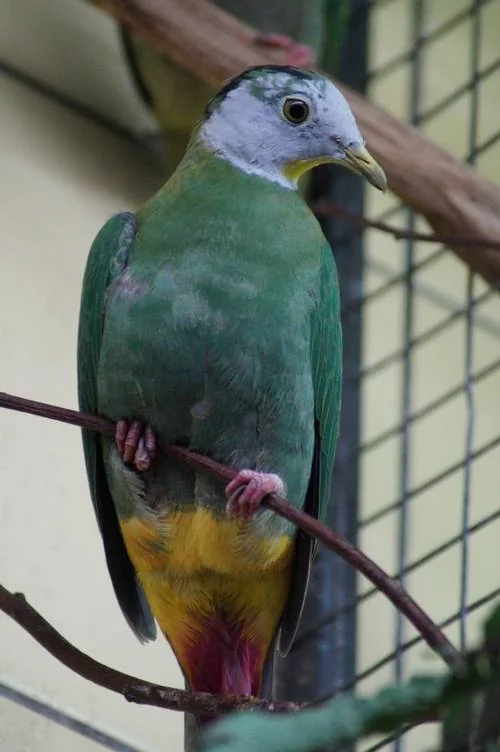
Image credits
Schwarznacken-Fruchttaube im Zoo Köln (© Thomas Breuer)