Fruit dove profile
African Green Pigeon (Treron calvus)
Species at a glance
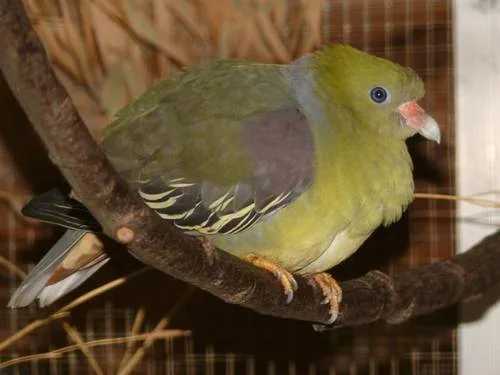
The African Green Pigeon (Treron calvus) is a robust African green pigeon with green plumage, dull burgundy shoulder areas and a pale bill with a red base. It is widespread across sub-Saharan Africa. Birds recorded within the European Fruit Dove Project belong to at least four subspecies, and the precise identity of part of the stock remains unresolved.
- Distribution
- Sub-Saharan Africa from West Africa to the Horn of Africa and south to Namibia, Botswana, Mozambique and South Africa; also including islands such as Bioko, Príncipe and Zanzibar.
- Size / characteristics
- about 25–30 cm | green to greenish-grey plumage, dull burgundy shoulder areas and whitish bill with red base and red cere | sexes externally similar, female generally slightly duller
- Status
- At least four subspecies represented; each stock is small and some subspecies identities remain unresolved
Description
The African Green Pigeon occupies a broad and regionally complex range. Typical features include green upperparts, greenish-grey underparts, dull burgundy shoulder areas and a whitish bill with a red base and conspicuous cere. Males and females are externally similar, although females often appear slightly duller. The species may gather in groups at productive fruiting trees and moves skilfully through branches while feeding. AviList recognises 15 subspecies. Reliable documentation of origin, characters and pairings is therefore especially important in the project stock.
Profile & short facts for African Green Pigeon
| English name | African Green Pigeon |
|---|---|
| German name | Rotnasen-Grüntaube |
| Scientific name | Treron calvus |
| Genus | Treron |
| Category | Treron - green pigeons |
| Distribution | Sub-Saharan Africa from West Africa to the Horn of Africa and south to Namibia, Botswana, Mozambique and South Africa; also including islands such as Bioko, Príncipe and Zanzibar. |
| Subspecies | Fifteen recognised subspecies: T. c. nudirostris, T. c. sharpei, T. c. calvus, T. c. poensis, T. c. virescens, T. c. uellensis, T. c. gibberifrons, T. c. brevicera, T. c. wakefieldii, T. c. granti, T. c. salvadorii, T. c. ansorgei, T. c. schalowi, T. c. vylderi and T. c. delalandii. |
| Size / characteristics | about 25–30 cm | green to greenish-grey plumage, dull burgundy shoulder areas and whitish bill with red base and red cere | sexes externally similar, female generally slightly duller |
| Status | At least four subspecies represented; each stock is small and some subspecies identities remain unresolved |
Habitat and natural range
Moist and dry forest, open woodland, wooded savanna, gallery forest, forest edges and wooded cultivated landscapes with sufficient fruiting trees.
Feeding in the European Fruit Dove Project
The species feeds mainly on fleshy fruit and berries, particularly figs. In human care, a varied selection of suitable fruits should be combined with a balanced complementary food for frugivorous pigeons. Several feeding sites and records of food intake and body condition are useful for the small subspecies populations.
Husbandry in the European Fruit Dove Project
This active and climbing green pigeon requires a spacious, densely structured and permanently frost-free aviary with open flight paths, perches of different thicknesses and protected retreat areas. Multiple feeding and escape sites help limit competition. Birds of unresolved subspecies identity must not be paired indiscriminately with clearly identified lines.
Breeding and offspring
Quiet, well-screened and load-bearing nest sites with suitable twig material should be offered. Because at least four subspecies are held within the project, origin, subspecies, individual identification, pair formation, pedigree, laying, hatching and juvenile development must be documented completely.
Subspecies and systematics
Fifteen recognised subspecies: T. c. nudirostris, T. c. sharpei, T. c. calvus, T. c. poensis, T. c. virescens, T. c. uellensis, T. c. gibberifrons, T. c. brevicera, T. c. wakefieldii, T. c. granti, T. c. salvadorii, T. c. ansorgei, T. c. schalowi, T. c. vylderi and T. c. delalandii.
Special notes on the species
The red bill base and cere give the species its German name. The former project list of 17 subspecies included forms that are no longer recognised or are now assigned differently; AviList recognises 15.
Conservation status
| IUCN | Least Concern |
|---|---|
| CITES | Not listed |
| EU species protection | Not listed |
| Ring size | 7,5–8,0 mm |
Further sources
Images of the African Green Pigeon
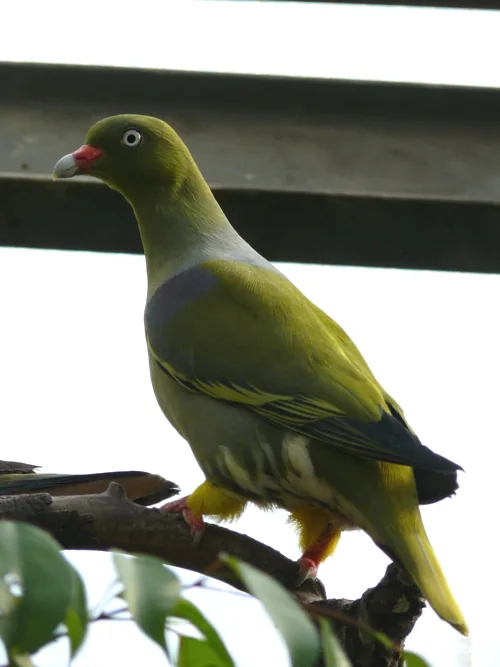
Image credits
- Rotnasen-Grüntaube tansanischem Ursprungs bei Noël Hendrikx (© Johannes Pfleiderer)
- Rotnasen-Grüntaube westafrikanischen Ursprungs im Zoo Pilsen (© Johannes Pfleiderer)
- Rotnasen-Grüntaube - Unterart delalandii - bei Henk Nabenman (© Johannes Pfleiderer)