Fruit dove profile
Thick-billed Green Pigeon (Treron curvirostra)
Species at a glance
The Thick-billed Green Pigeon (Treron curvirostra) is a medium-sized Asian green pigeon with a robust bill, green orbital skin and pronounced sexual dimorphism. Its range extends from the Himalayan foothills and southern China to the Malay Peninsula, Sumatra, Borneo and western islands of the Philippines. It is currently not represented in the project stock.
- Distribution
- From southern Nepal, northeastern India, Myanmar and southern China through Indochina to the Malay Peninsula; also Sumatra, Borneo, Hainan, Hong Kong, Palawan and Mindoro, and several islands west of Sumatra.
- Size / characteristics
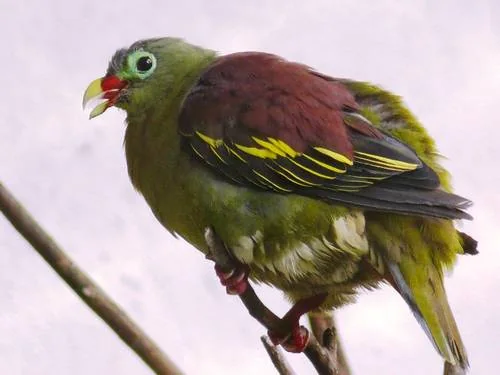
- about 24–31 cm | robust pale bill with reddish base, green bare orbital skin and predominantly green plumage | male with chestnut to burgundy mantle and shoulder area, female green in these regions
- Status
- Currently not represented in the project stock
Description
The Thick-billed Green Pigeon is readily identified by its robust curved bill and green bare orbital area. The male has chestnut to burgundy mantle and shoulder areas, whereas these regions remain green in the female. Both sexes are predominantly green with yellowish wing markings. AviList recognises seven subspecies, including several island endemics off western Sumatra. The former project statement that subspecies were generally no longer recognised is therefore outdated.
Profile & short facts for Thick-billed Green Pigeon
| English name | Thick-billed Green Pigeon |
|---|---|
| German name | Papageischnabel-Grüntaube |
| Scientific name | Treron curvirostra |
| Genus | Treron |
| Category | Treron - green pigeons |
| Distribution | From southern Nepal, northeastern India, Myanmar and southern China through Indochina to the Malay Peninsula; also Sumatra, Borneo, Hainan, Hong Kong, Palawan and Mindoro, and several islands west of Sumatra. |
| Subspecies | Seven recognised subspecies: T. c. nipalensis – Himalayan foothills to Indochina | T. c. hainanus – Hainan, Guangdong and Hong Kong | T. c. curvirostra – Malay Peninsula, Sumatra, Borneo, Palawan and Mindoro | T. c. haliplous – Simeulue | T. c. pegus – Nias | T. c. smicrus – Batu and Mentawai Islands | T. c. hypothapsinus – Enggano. |
| Size / characteristics | about 24–31 cm | robust pale bill with reddish base, green bare orbital skin and predominantly green plumage | male with chestnut to burgundy mantle and shoulder area, female green in these regions |
| Status | Currently not represented in the project stock |
Habitat and natural range
Tropical and subtropical lowland and hill forest, swamp and gallery forest, forest edges, mature secondary woodland, mangroves and regionally wooded plantations.
Feeding in the European Fruit Dove Project
The species feeds mainly on fruit, berries and figs. The robust bill helps grip and process food; the unsupported claim that it cracks hard fruit shells is not retained. In human care, a varied fruit ration should be combined with a balanced complementary food for frugivorous pigeons.
Husbandry in the European Fruit Dove Project
This agile canopy species requires a spacious, densely structured and permanently frost-free aviary with open flight paths, perches of different thicknesses and protected retreat areas. Multiple feeding sites help limit competition. No current project-specific husbandry experience is available.
Breeding and offspring
Quiet, well-screened and elevated nest sites with suitable twig material should be offered in any future holding. As the species is currently absent from the project stock, no recent project data on pair formation, incubation or juvenile development are available.
Subspecies and systematics
Seven recognised subspecies: T. c. nipalensis – Himalayan foothills to Indochina | T. c. hainanus – Hainan, Guangdong and Hong Kong | T. c. curvirostra – Malay Peninsula, Sumatra, Borneo, Palawan and Mindoro | T. c. haliplous – Simeulue | T. c. pegus – Nias | T. c. smicrus – Batu and Mentawai Islands | T. c. hypothapsinus – Enggano.
Special notes on the species
The robust bill and green orbital skin are important identification features. AviList recognises seven subspecies, including four very restricted island forms west of Sumatra.
Conservation status
| IUCN | Least Concern |
|---|---|
| CITES | Not listed |
| EU species protection | Not listed |
| Ring size | 7,0 mm |
Further sources
Images of the Thick-billed Green Pigeon
Image credits
Papageischnabeltaube (© Johannes Pfleiderer)