Fruit dove profile
Collared Imperial Pigeon (Ducula mullerii)
Species at a glance
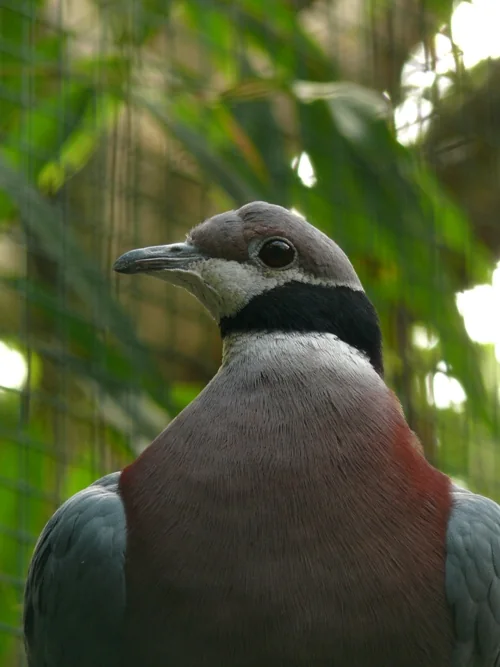
The Collared Imperial Pigeon (Ducula mullerii) is a large imperial pigeon of New Guinea with a complete black collar, maroon back and dark tail crossed by a pale band. Two subspecies are recognised. The project stock is currently very small.
- Distribution
- New Guinea including the Aru Islands, together with Boigu and other northwestern Torres Strait islands.
- Size / characteristics
- about 38–41 cm | broad black collar narrowing at the front, maroon back and dark tail with a pale transverse band | sexes externally similar
- Status
- Project stock very small
Description
The Collared Imperial Pigeon is readily identified by the broad black collar that narrows at the front. It meets the maroon back, while the dark tail carries a conspicuous pale transverse band. Males and females are externally similar. The species is closely associated with river systems, seasonally flooded forest, swamp forest and mangroves in New Guinea and may move nomadically in response to fruit availability. The very small project stock requires careful coordination of origin, subspecies and pair formation.
Profile & short facts for Collared Imperial Pigeon
| English name | Collared Imperial Pigeon |
|---|---|
| German name | Schwarzhals-Fruchttaube |
| Scientific name | Ducula mullerii |
| Genus | Ducula |
| Category | Ducula - imperial pigeons |
| Distribution | New Guinea including the Aru Islands, together with Boigu and other northwestern Torres Strait islands. |
| Subspecies | Ducula m. mullerii – southern New Guinea including Aru, and Boigu and Daru islands | Ducula m. aurantia – lowlands of northern New Guinea from Cenderawasih Bay to Astrolabe Bay. |
| Size / characteristics | about 38–41 cm | broad black collar narrowing at the front, maroon back and dark tail with a pale transverse band | sexes externally similar |
| Status | Project stock very small |
Habitat and natural range
Riverine and floodplain forest, seasonally inundated lowland forest, swamp forest and mangroves, with adjacent forest edges used regionally.
Feeding in the European Fruit Dove Project
The species feeds mainly on fruit and berries and may track the availability of fruiting trees regionally. In human care, a varied fruit ration should be combined with a balanced complementary food for frugivorous pigeons. In the very small stock, food intake, body weight and condition should be documented regularly.
Husbandry in the European Fruit Dove Project
This large and powerful species requires a spacious, structured and permanently frost-free aviary with long unobstructed flight paths, stable elevated perches and protected resting areas. Multiple feeding sites and escape options are especially important in group housing. The indoor climate should remain stable and free from draughts.
Breeding and offspring
The clutch normally consists of a single egg. Quiet, elevated and particularly load-bearing nest sites with sturdy twig material should be provided. In the very small project stock, subspecies, origin, pair formation, pedigree, hatching and juvenile development must be recorded completely.
Subspecies and systematics
Ducula m. mullerii – southern New Guinea including Aru, and Boigu and Daru islands | Ducula m. aurantia – lowlands of northern New Guinea from Cenderawasih Bay to Astrolabe Bay.
Special notes on the species
The complete black collar is unmistakable. More than many other Ducula species, it is associated with riverine, flooded and mangrove habitats.
Conservation status
| IUCN | Least Concern |
|---|---|
| CITES | Not listed |
| EU species protection | Not listed |
| Ring size | 11,0 mm |
Further sources
Images of the Collared Imperial Pigeon
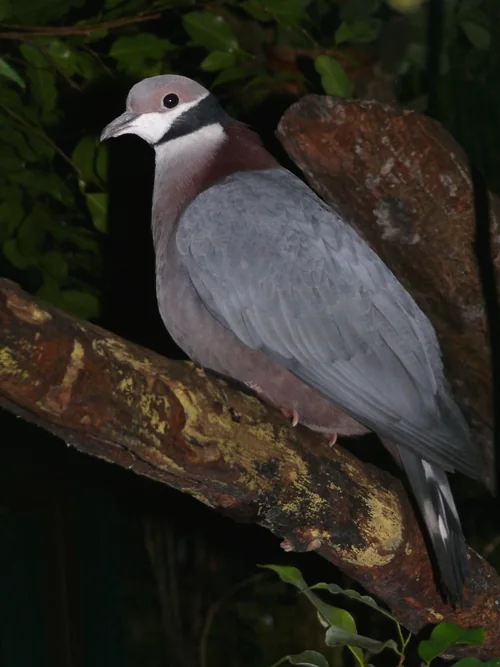
Image credits
- Schwarzhals-Fruchttaube im Vogelpark Walsrode (© Johannes Pfleiderer)
- 1.1 Schwarzhals-Fruchttauben im Vogelpark Walsrode (© Johannes Pfleiderer)