Fruit dove profile
Pacific Imperial Pigeon (Ducula pacifica)
Species at a glance
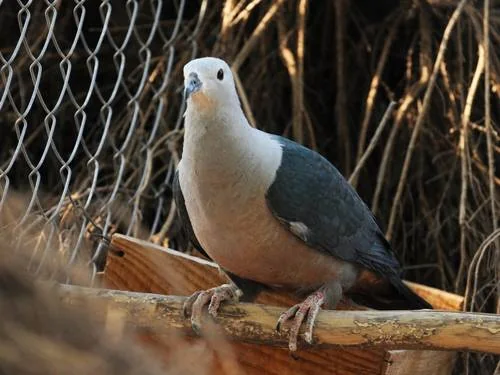
The Pacific Imperial Pigeon (Ducula pacifica) is a large fruit-eating pigeon of Melanesia and Polynesia. It is recognised by its pale grey to pinkish-grey underparts and prominent knob at the base of the bill, usually more developed in males. The species is currently not represented within the European Fruit Dove Project.
- Distribution
- Islands north and southeast of New Guinea, extending from the Bismarck and Louisiade archipelagos through the Solomon Islands and Vanuatu to Fiji, Samoa, Tonga, Niue and the Cook Islands.
- Size / characteristics
- about 36–41 cm | around 370–420 g | grey to pinkish-grey underparts, darker upperparts and a prominent knob at the base of the bill, usually larger in males
- Status
- Currently not represented in the project stock
Description
The Pacific Imperial Pigeon is distributed across numerous island groups in the south-western and central Pacific. Its robust build, grey to pinkish-grey plumage and prominent bill knob make it distinctive. The species can travel between islands and widely separated fruiting trees and may gather in larger flocks at abundant food sources. Two subspecies are recognised. As the species is not currently held within the project, husbandry and breeding information must be identified as general specialist knowledge rather than direct project experience.
Profile & short facts for Pacific Imperial Pigeon
| English name | Pacific Imperial Pigeon |
|---|---|
| German name | Tongafruchttaube |
| Scientific name | Ducula pacifica |
| Genus | Ducula |
| Category | Ducula - imperial pigeons |
| Distribution | Islands north and southeast of New Guinea, extending from the Bismarck and Louisiade archipelagos through the Solomon Islands and Vanuatu to Fiji, Samoa, Tonga, Niue and the Cook Islands. |
| Subspecies | Ducula p. pacifica – from the Louisiade Archipelago through the Solomon Islands, Vanuatu and Fiji to Samoa, Tonga, Niue and the Cook Islands | Ducula p. sejuncta – smaller islands north of New Guinea and the western Bismarck Archipelago. |
| Size / characteristics | about 36–41 cm | around 370–420 g | grey to pinkish-grey underparts, darker upperparts and a prominent knob at the base of the bill, usually larger in males |
| Status | Currently not represented in the project stock |
Habitat and natural range
Tropical lowland and montane forest on islands, forest edges, secondary growth and wooded cultivated landscapes with fruiting trees.
Feeding in the European Fruit Dove Project
The species feeds mainly on fruit but also takes young leaves and flowers. In human care, the diet should include a varied selection of suitable fruits and a balanced complementary food for frugivorous pigeons. Because of the species' size and activity, feeding areas should allow several birds to feed simultaneously without competition.
Husbandry in the European Fruit Dove Project
As a powerful and sustained island flyer, the species requires ample usable flight space, stable elevated perches and protected resting areas. Housing must remain frost-free throughout the year and include a weather-protected indoor section. In group housing, sufficient spacing, multiple feeding sites and behaviour during seasonal pair formation require close observation.
Breeding and offspring
The species builds a simple twig nest in trees or elevated locations, and the clutch normally consists of a single egg. Stable high nesting platforms and suitable nesting material should be provided in an aviary. As no birds are currently recorded within the project, there are no recent project data on incubation, rearing or pair compatibility.
Subspecies and systematics
Ducula p. pacifica – from the Louisiade Archipelago through the Solomon Islands, Vanuatu and Fiji to Samoa, Tonga, Niue and the Cook Islands | Ducula p. sejuncta – smaller islands north of New Guinea and the western Bismarck Archipelago.
Special notes on the species
The prominent knob at the base of the bill and regular flights between islands are characteristic features. The species also has cultural significance on many Pacific islands and is known locally by names such as “Lupe”.
Conservation status
| IUCN | Least Concern |
|---|---|
| CITES | Not listed |
| EU species protection | Not listed |
| Ring size | 11,0 mm |
Further sources
Images of the Pacific Imperial Pigeon
Image credits
Schwarzhöcker-Fruchttaube bei Henk Naberman (© Johannes Pfleiderer)