Fruit dove profile
Wallace's Fruit Dove (Ptilinopus wallacii)
Species at a glance
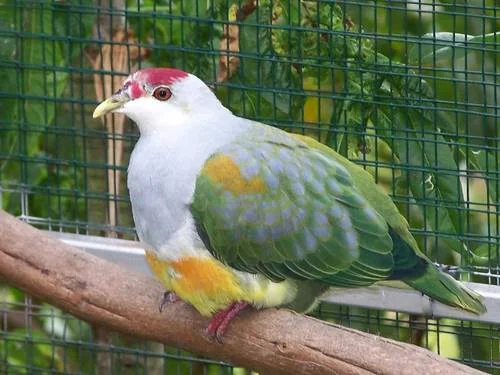
Wallace's Fruit Dove (Ptilinopus wallacii) is a medium-sized, vividly patterned island pigeon with a red crown, white face and throat, bluish-grey breast and orange belly. It occurs on islands of the southern Moluccas, the Aru Islands and in southwestern New Guinea. It is no longer represented within the European Fruit Dove Project.
- Distribution
- Southern Moluccas and eastern Lesser Sunda Islands including Tanimbar, Kei and Aru, and southwestern New Guinea.
- Size / characteristics
- about 24–28 cm | crimson crown, white face and throat, bluish-grey breast, white transverse band and orange belly | female usually with less red and slightly greener grey areas
- Status
- No longer represented in the project stock
Description
Wallace's Fruit Dove is one of the most strongly contrasting Ptilinopus species. The forehead and crown are dull crimson, the face and throat are white, and the neck and breast are bluish-grey. A white band separates the breast from the orange belly, while the wings and back are green. Males and females are similar, but the female usually has less red on the head and greener-grey areas. The species is monotypic. The project population has been lost; according to existing records, the last known European bird died.
Profile & short facts for Wallace's Fruit Dove
| English name | Wallace's Fruit Dove |
|---|---|
| German name | Weißkehl-Fruchttaube |
| Scientific name | Ptilinopus wallacii |
| Genus | Ptilinopus |
| Category | Ptilinopus - fruit doves |
| Distribution | Southern Moluccas and eastern Lesser Sunda Islands including Tanimbar, Kei and Aru, and southwestern New Guinea. |
| Subspecies | Monotypic; no subspecies are currently widely recognised. |
| Size / characteristics | about 24–28 cm | crimson crown, white face and throat, bluish-grey breast, white transverse band and orange belly | female usually with less red and slightly greener grey areas |
| Status | No longer represented in the project stock |
Habitat and natural range
Tropical moist lowland and hill forest, swamp forest, forest edges and mature secondary woodland.
Feeding in the European Fruit Dove Project
The species feeds mainly on small to medium-sized fruits and berries taken in the canopy. In human care, a varied fruit ration should be combined with a balanced complementary food for frugivorous pigeons. As no project birds remain, there are no current project-specific long-term data.
Husbandry in the European Fruit Dove Project
This active and disturbance-sensitive species requires a spacious, densely structured and permanently frost-free aviary with open flight paths, a mixture of fine and sturdy perches, and protected retreat areas. Calm routines and multiple feeding sites are important. Statements on mixed-species housing should be based only on reliable observations.
Breeding and offspring
Well-screened elevated nest sites with fine to sturdy twig material should be offered in any future holding. As the European project stock has been lost, there are no recent project-specific data on pair formation, incubation or juvenile development.
Subspecies and systematics
Monotypic; no subspecies are currently widely recognised.
Special notes on the species
The combination of a red crown, white throat, bluish-grey breast, white band and orange belly is almost unmistakable.
Conservation status
| IUCN | Least Concern |
|---|---|
| CITES | Not listed |
| EU species protection | Not listed |
| Ring size | 7,0 mm |
Further sources
Images of the Wallace's Fruit Dove
Image credits
Weißkehl-Fruchttaube (© Valentin Castiñeira)