Fruit dove profile
Bruce's Green Pigeon (Treron waalia)
Species at a glance
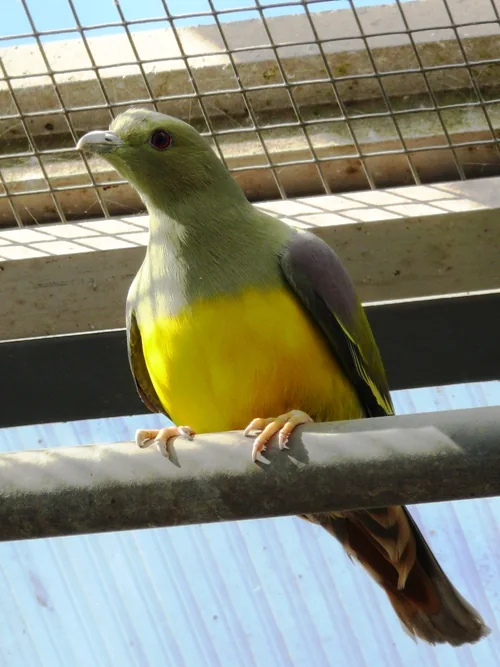
Bruce's Green Pigeon (Treron waalia) is a medium-sized green pigeon of African savannas and dry regions and southwestern Arabia. It is characterised by an olive-green body, purple shoulder patches and a vivid yellow belly. The monotypic species has a secure stock within the European Fruit Dove Project.
- Distribution
- Savanna and dry regions from West Africa through the Sahel to Sudan, Ethiopia, Somalia, Uganda and Kenya; also southwestern Arabia and Socotra.
- Size / characteristics
- about 28–30 cm | olive-green to greenish-grey head and upperparts, purple shoulder patches and vivid yellow underparts | sexes externally similar, female usually slightly duller
- Status
- Project stock secure
Description
Bruce's Green Pigeon ranges from the West African Sahel through northeastern and eastern Africa to the southwestern Arabian Peninsula and Socotra. The head, neck and upper breast are olive to greenish-grey, the wings are dark olive-green and the underparts are conspicuously yellow. Purple shoulder patches complete the pattern. Males and females are externally very similar, although females may appear slightly duller. The species is monotypic. It tracks fruiting trees regionally and feeds particularly often on figs.
Profile & short facts for Bruce's Green Pigeon
| English name | Bruce's Green Pigeon |
|---|---|
| German name | Waaliagrüntaube |
| Scientific name | Treron waalia |
| Genus | Treron |
| Category | Treron - green pigeons |
| Distribution | Savanna and dry regions from West Africa through the Sahel to Sudan, Ethiopia, Somalia, Uganda and Kenya; also southwestern Arabia and Socotra. |
| Subspecies | Monotypic; no subspecies are currently widely recognised. |
| Size / characteristics | about 28–30 cm | olive-green to greenish-grey head and upperparts, purple shoulder patches and vivid yellow underparts | sexes externally similar, female usually slightly duller |
| Status | Project stock secure |
Habitat and natural range
Dry and moister savanna, open woodland, wooded river valleys, gallery forest, oases and other sites with fruiting trees.
Feeding in the European Fruit Dove Project
The species feeds mainly on fruit and uses figs particularly often. The former statement that it feeds almost exclusively on a single fig species is not generalised. In human care, a varied fruit ration should be combined with a balanced complementary food for frugivorous pigeons.
Husbandry in the European Fruit Dove Project
This active and social species requires a spacious, well-structured and permanently frost-free aviary with open flight paths, perches of different thicknesses and protected retreat areas. Multiple feeding sites facilitate the management of small groups. The secure stock should continue to be documented by origin and pedigree.
Breeding and offspring
Quiet, well-screened and load-bearing nest sites with suitable twig material should be offered. In the secure project stock, pair formation, individual identification, pedigree, laying, hatching and juvenile development should continue to be recorded consistently.
Subspecies and systematics
Monotypic; no subspecies are currently widely recognised.
Special notes on the species
The yellow belly clearly distinguishes the species from the African Green Pigeon. Bruce's Green Pigeon is monotypic and occurs not only in Africa but also in southwestern Arabia and on Socotra.
Conservation status
| IUCN | Least Concern |
|---|---|
| CITES | Not listed |
| EU species protection | Not listed |
| Ring size | 8,0 mm |
Further sources
Images of the Bruce's Green Pigeon
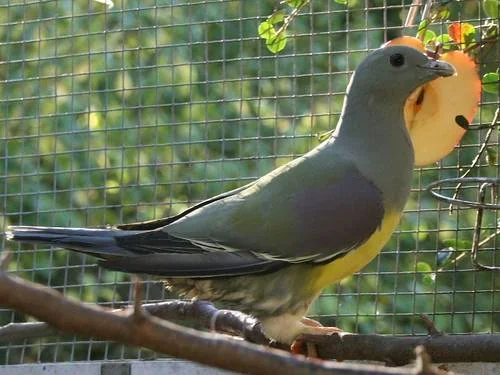
Image credits
- Waalia-Taube (© Angelika Zastrow)
- Waalia-Taube (© Simon Bruslund)
- Waalia-Taube (© Johannes Pfleiderer)