Fruit dove profile
Beautiful Fruit Dove (Ptilinopus pulchellus (Temminck, 1835))
Species at a glance
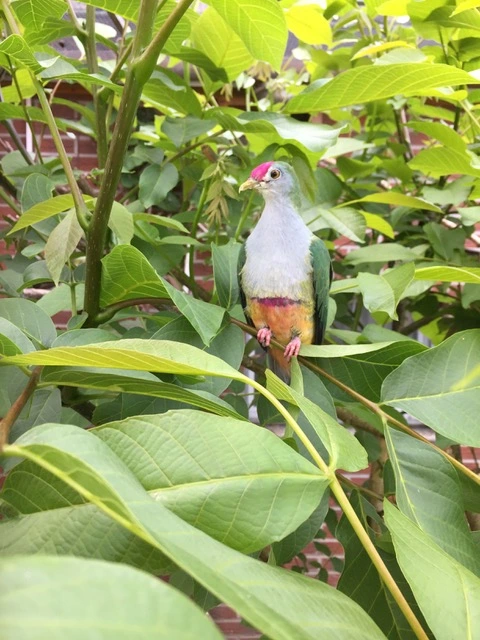
The Beautiful Fruit Dove (Ptilinopus pulchellus) is a small and strikingly colourful fruit dove native to the tropical forests of New Guinea and the Raja Ampat Islands. Its most distinctive features include a bright red crown, pale blue-grey breast and yellow-orange belly. This predominantly arboreal species feeds mainly on fruits and berries.
- Distribution
- New Guinea Raja Ampat Islands: Waigeo, Batanta, Salawati and Misool
- Size / characteristics
- Body length: approx. 18–20 cm Weight: approx. 68–76 g Red to purplish-red crown Pale to blue-grey breast Green upperparts and wings Purple breast band Yellow-orange belly Sexes are difficult to distinguish reliably by appearance Juveniles initially predominantly greenish to grey-green
- Status
- The population of the Beautiful Fruit Dove within the European Fruit Dove Project is currently considered secure. The species is bred regularly. The aim of the project is to maintain a stable and genetically diverse European population over the long term and to safeguard the existing breeding lines through coordinated exchanges and documented breeding.
Description
The Beautiful Fruit Dove is one of the smaller members of the genus Ptilinopus, reaching approximately 18–20 cm in length and weighing around 68–76 g.
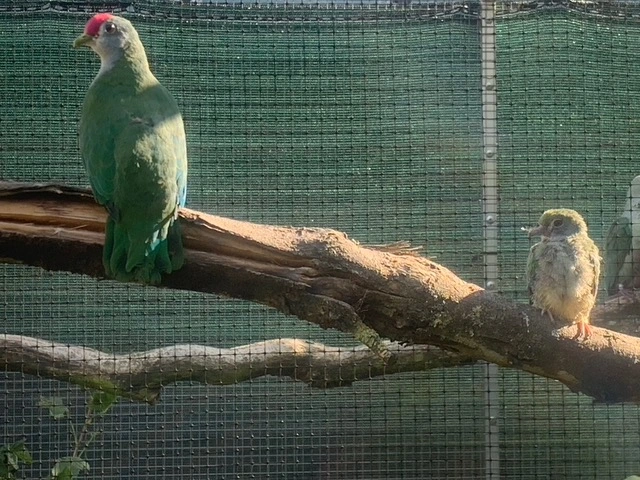
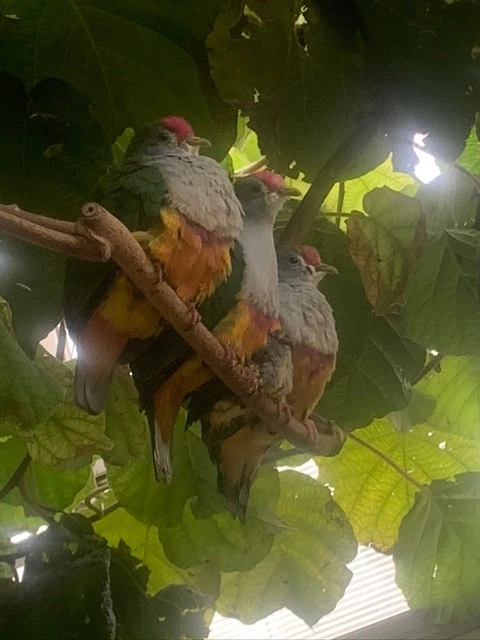
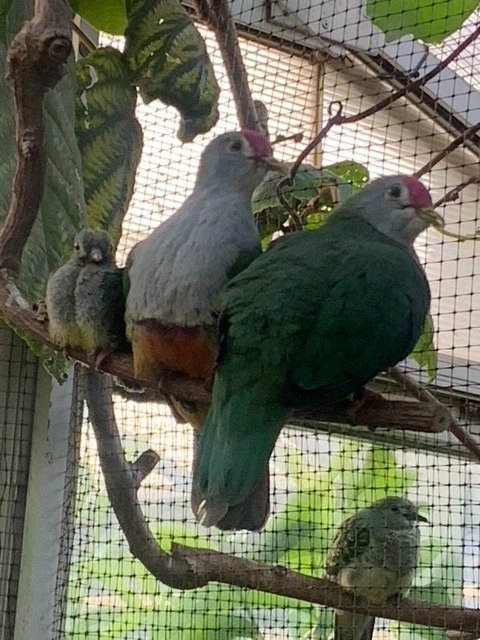
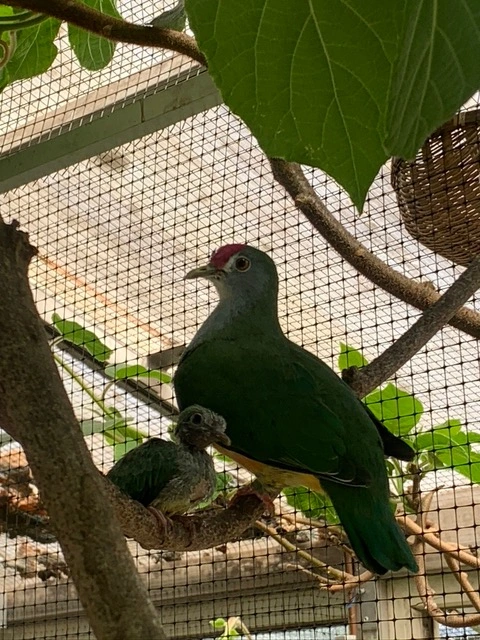
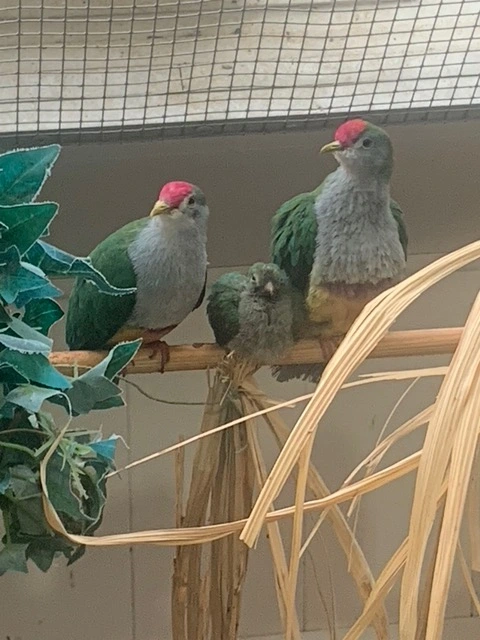
Adult birds are strikingly coloured. The crown is bright crimson to purplish red, while the throat and cheeks are pale and the breast is grey to blue-grey. The back, wings and tail are various shades of green. A conspicuous purple to wine-red band separates the breast from the yellow-orange belly.
Males and females are very similar in appearance. Fully coloured males may show a slightly larger red crown, a paler throat and more extensive purple and orange plumage. However, plumage characteristics alone are not always sufficient for reliable sex determination, particularly in young birds, and DNA sexing provides greater certainty.
Juveniles are initially much less colourful than adults. Their plumage is predominantly green to grey-green, with the characteristic red crown and bright breast and belly colours developing gradually during the juvenile moult.
The species is predominantly arboreal and feeds mainly on fruits and berries, many of which are swallowed whole. By dispersing seeds, fruit doves play an important ecological role in tropical forest ecosystems.
Profile & short facts for Beautiful Fruit Dove
| English name | Beautiful Fruit Dove |
|---|---|
| German name | Rotkappen-Fruchttaube |
| Scientific name | Ptilinopus pulchellus (Temminck, 1835) |
| Genus | Ptilinopus |
| Category | Ptilinopus - fruit doves |
| Distribution | New Guinea Raja Ampat Islands: Waigeo, Batanta, Salawati and Misool |
| Subspecies | No currently recognised subspecies; according to the current IOC taxonomy, the species is treated as monotypic. Historically, Ptilinopus pulchellus pulchellus and Ptilinopus pulchellus decorus were distinguished. |
| Size / characteristics | Body length: approx. 18–20 cm Weight: approx. 68–76 g Red to purplish-red crown Pale to blue-grey breast Green upperparts and wings Purple breast band Yellow-orange belly Sexes are difficult to distinguish reliably by appearance Juveniles initially predominantly greenish to grey-green |
| Status | The population of the Beautiful Fruit Dove within the European Fruit Dove Project is currently considered secure. The species is bred regularly. The aim of the project is to maintain a stable and genetically diverse European population over the long term and to safeguard the existing breeding lines through coordinated exchanges and documented breeding. |
| Note | Ältere Systematiken und die bisherige Datenbasis des Europäischen Fruchttaubenprojekts unterscheiden Ptilinopus pulchellus pulchellus und Ptilinopus pulchellus decorus. Die aktuelle IOC World Bird List behandelt Ptilinopus pulchellus dagegen als monotypische Art; decorus wird nicht mehr als gültige Unterart anerkannt. Für diesen Steckbrief wird der aktuellen IOC-Systematik gefolgt. Die historische Unterarteneinteilung bleibt zur Nachvollziehbarkeit dokumentiert. |
Habitat and natural range
The Beautiful Fruit Dove inhabits humid tropical primary and secondary forests of New Guinea and neighbouring islands. It occurs both in lowland forests and in forested higher elevations and uses different vegetation layers from the understory to the canopy.
The species is predominantly arboreal and is often observed alone or in pairs. Fruit-bearing trees are important feeding sites.
Feeding in the European Fruit Dove Project
The natural diet consists predominantly of fruits and berries from various trees, shrubs, palms and climbing plants. Fruits are often swallowed whole.
In human care, a varied diet specifically suited to fruit doves should be provided. Suitable fruits and seasonal berries as well as high-quality specialist food formulated for frugivorous birds have proven appropriate.
Based on husbandry experience within the European Fruit Dove Project, foods such as apple, banana, pear, grapes, blueberries, currants, Mahonia berries and elderberries are readily accepted. Specialist frugivore pellets may be used to supplement the diet.
Fresh food and drinking water should be provided daily. Fruit remains should be removed regularly because of their rapid spoilage.
Husbandry in the European Fruit Dove Project
As a tropical fruit dove, Ptilinopus pulchellus requires warm, draught-free and protected accommodation with sufficient natural structure and several suitable perching opportunities.
Based on long-term husbandry experience within the European Fruit Dove Project, temperatures of around 18 °C or above are recommended. Recently fledged juveniles are particularly sensitive to low temperatures.
The species is generally considered relatively peaceful and may, under suitable conditions, be kept in mixed-species aviaries. Compatibility should nevertheless always be monitored individually. Territorial or aggressive behaviour may occur, particularly during the breeding season and when housed together with other fruit dove species.
A well-planted and structurally diverse aviary with retreat areas, perches at different heights and suitable nesting sites supports the species' natural behaviour.
Breeding and offspring
As is typical for many fruit doves, the nest consists of a relatively loose platform of twigs. The clutch normally consists of a single white to cream-coloured egg.
Both parents participate in raising the chick. Initially, the young bird is fed the crop milk typical of pigeons and doves and is later increasingly provided with pre-digested food.
Incubation periods of approximately 15–18 days have been reported for Ptilinopus pulchellus. Young birds may leave the nest after approximately 8–14 days but continue to depend on and be cared for by their parents afterwards.
Juveniles initially have predominantly greenish-grey plumage. The red crown and the strong adult colours develop only gradually during the juvenile moult.
Disturbance should be kept to a minimum during incubation and chick rearing. A varied fruit-based diet and a warm, protected environment are particularly important for recently fledged juveniles.
Subspecies and systematics
No currently recognised subspecies; according to the current IOC taxonomy, the species is treated as monotypic.
Historically, Ptilinopus pulchellus pulchellus and Ptilinopus pulchellus decorus were distinguished.
Special notes on the species
The Beautiful Fruit Dove is one of the smaller species of the genus Ptilinopus.
Males and females are very similar in appearance; in juveniles and birds that have not yet attained full adult plumage, reliable sex determination based on plumage is difficult.
The characteristic red crown and the intense colours of the breast and belly develop in juveniles only during the juvenile moult.
Despite its small body size, the species is capable of swallowing comparatively large fruits whole.
Conservation status
| IUCN | Least Concern |
|---|---|
| CITES | Not listed |
| EU species protection | Not listed |
| Ring size | 5,5 mm |
Further sources
Images of the Beautiful Fruit Dove